
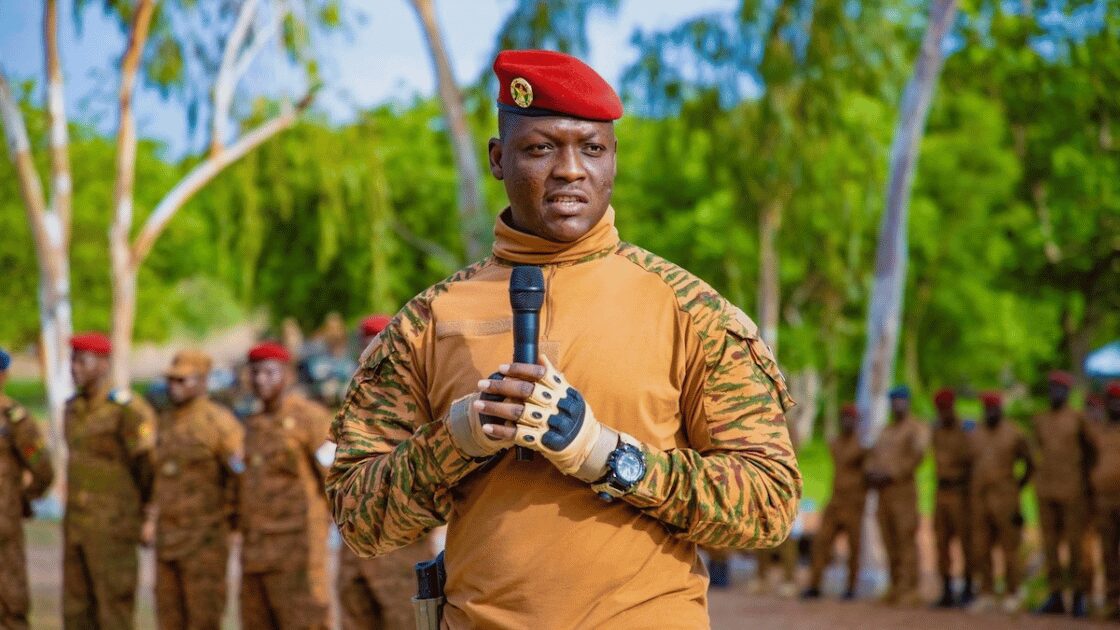
In the most unambiguous rejection of democratic governance by any African leader in recent memory, Burkina Faso’s military ruler Captain Ibrahim Traoré has told his people to abandon all hope of returning to democratic rule declaring the system a killer and a tool of foreign oppression.
Speaking in a lengthy interview broadcast on state television on Thursday night, Traoré said: “People need to forget about the issue of democracy. Democracy is not for us.”
The remarks, which have since reverberated across the continent and beyond, go further than anything Traoré has publicly stated before and arrive just three months after his government took the extraordinary step of dissolving every political party in the country.
Traoré invoked Libya as a cautionary tale, claiming that outsiders had tried to impose democracy there and failed. He went further, saying: “Democracy kills. Look at Libya; it’s a prime example right next to us! Everywhere they try to establish democracy in the world, it’s done with bloodshed… Democracy is slavery.”
Traoré, who casts himself as a revolutionary leader standing up to Western imperialism, pointed out that Libya under Muammar Gaddafi for all its authoritarianism provided its citizens with subsidised housing, free education, and free healthcare. For Traoré, the argument is simple: stability and sovereignty matter more than the ballot box.
On the dissolution of political parties, he said he considered them divisive, dangerous, and incompatible with the revolutionary process, stating: “The truth is, politics in Africa or at least what we’ve experienced in Burkina is that a real politician is someone who embodies every vice: a liar, a sycophant, a smooth-talker.” The junta leader did not propose an alternative system but insisted: “We have our own approach.”
Traoré seized power in September 2022, eight months after an earlier military coup he was involved in overthrew the democratically elected government of President Roch Marc Kabore. He initially promised to organise elections in 2024. That promise was quietly buried.
Two months before the July 2024 deadline, the junta announced it would extend its rule for another five years. In January, authorities announced a ban on all political parties as part of a plan to “rebuild the state.”
The Independent National Electoral Commission was dissolved in July 2025 after the government claimed the agency was too expensive. What remains of institutional democracy in Burkina Faso is now, by Traoré’s own admission, nothing more than a chapter to be forgotten.
While Traoré commands a devoted following across the African continent and diaspora for his fiery anti-Western, pan-Africanist rhetoric, a bleaker picture is emerging on the ground.
Traoré has suppressed dissent during his rule, cracking down on the opposition, media, and civil society groups. His government has even been accused of punishing critics by sending them to the front lines of the war against Islamist militants.
Analysts have raised concerns about the government’s apparent targeting of institutions including the media and judiciary. Journalists, political opposition leaders and prosecutors critical of the military government have been forcibly conscripted and sent to the front lines in recent months, with some later released.
And on the security front the very justification Traoré offers for suspending democratic governance the numbers tell a damning story. Fatalities tripled during Traoré’s first three years in power, reaching 17,775 by last May, with most of those killed being civilians — often at the hands of government forces or allied militias. A Human Rights Watch report released Thursday confirmed that more than 1,800 civilians have been killed since the junta took power.
Burkina Faso’s democratic retreat does not stand alone. Alongside Niger and Mali, the country exited the regional Economic Community of West African States (ECOWAS) bloc to form its own Alliance of Sahel States (AES). Similar moves against political parties have been taken by the neighbouring military governments in both countries, which are also battling armed group violence.
All three nations have moved away from working with Western countries particularly France in their fight against Islamist militants, turning instead towards Russia for military assistance. But the violence has continued unabated.
Traoré’s comments are not just a Burkinabé story. They signal a hardening ideological position that is reshaping political culture across the Sahel and sending tremors through the wider West African region.
While there has been a spate of military takeovers in recent years, most African countries do still hold regular elections, even if some are criticised as being rigged in favour of incumbents. Two military leaders in Gabon and Guinea have organised elections which they have gone on to win. Traoré, by contrast, has shown no interest in any such exercise.
Read Also: Authorities Claim Fresh Assassination Attempt Targeted Burkina Faso Leader Ibrahim Traoré
For countries like Sierra Leone and others in the Mano River Union region, where hard-won democratic institutions remain fragile and contested, Traoré’s defiant posture is a reminder of how thin the line between aspiration and authoritarian consolidation can be — and how quickly a coup leader’s promises can unravel.
The Burkinabé people, caught between a jihadist insurgency and a junta tightening its grip, were not asked whether they agreed with their leader’s verdict on democracy. In a country where political parties are banned and critics are sent to war zones, that question may be the most dangerous one of all.