
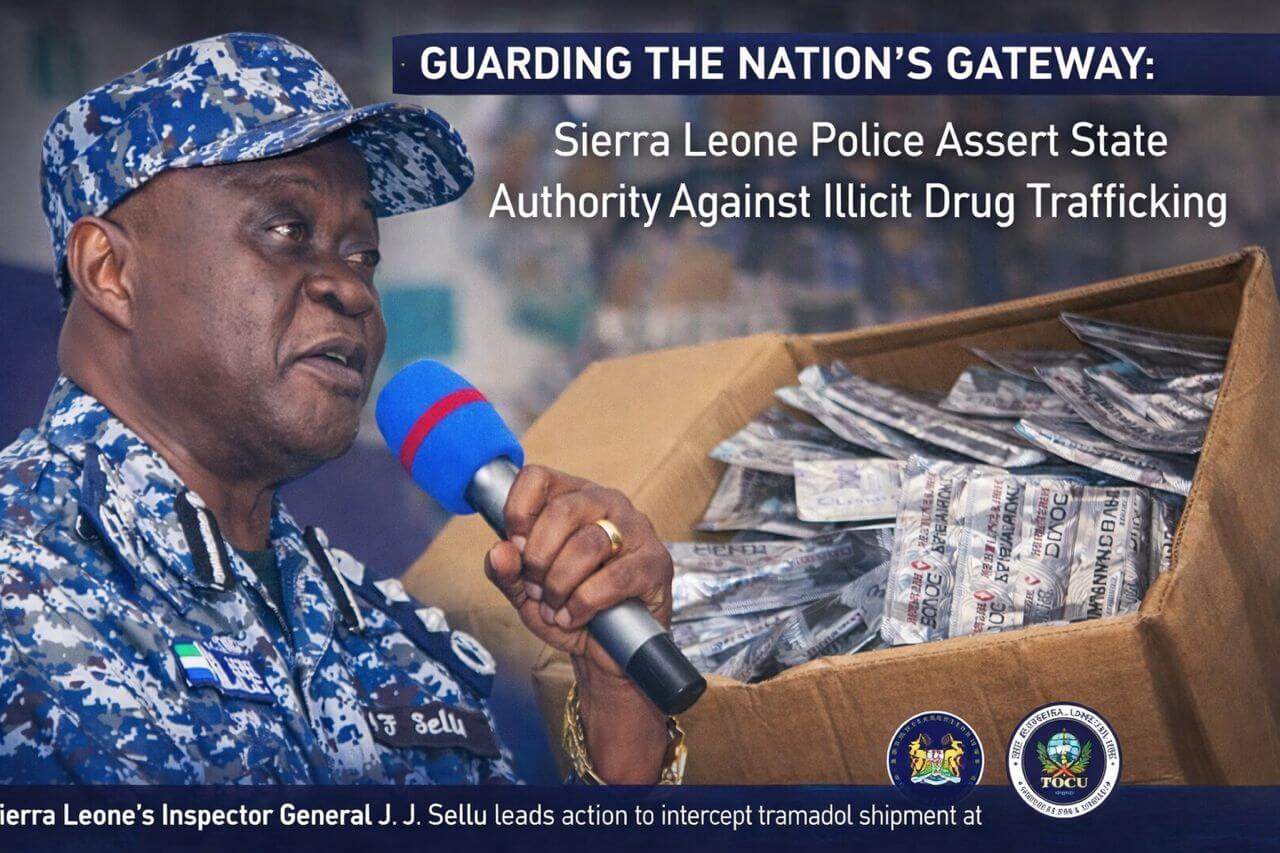
The interception of forty four cartons of suspected tramadol at the cargo warehouse of the Freetown International Airport in Lungi was neither dramatic nor disorderly. It unfolded quietly, guided by intelligence, precision, and institutional restraint. Yet its implications extend far beyond a single seizure, touching upon Sierra Leone’s constitutional responsibilities, regional obligations, and international commitments to security, public health, and the rule of law.
The operation was conducted by the Sierra Leone Police through the Airport Police Division following actionable intelligence regarding a cargo consignment believed to contain items of law enforcement concern. Officers, led by the Local Unit Commander, Chief Superintendent of Police Cecilia Akiebo Cole, executed a targeted and legally authorised search at the cargo terminal. This resulted in the discovery and securing of the suspected narcotics. One individual was detained in connection with the consignment, and both the suspect and the exhibits were formally transferred to the Transnational Organised Crime Unit for further investigation.
Police authorities have confirmed that investigations remain ongoing and that all procedures are being conducted in accordance with due process, including the presumption of innocence and strict adherence to evidentiary and procedural standards.
Constitutional grounding of police action
The actions of the Sierra Leone Police in this matter are firmly anchored in the Constitution of Sierra Leone, which identifies the security, peace, and welfare of the people as the primary purpose and responsibility of the state. Law enforcement institutions are constitutionally mandated to protect public order, prevent crime, and safeguard citizens from activities that threaten national stability or public health.
Illicit drug trafficking, particularly involving controlled pharmaceutical substances such as tramadol, poses significant risks to social cohesion, public safety, and youth welfare. According to the World Health Organization, the non medical use of tramadol has emerged as a growing public health concern in parts of Africa, contributing to dependency, increased risk of injury, and strain on already limited health systems.
Alignment with international legal obligations
Sierra Leone’s response is consistent with its international legal obligations as a member of the United Nations and a signatory to global drug control conventions. These frameworks require states to take effective measures to prevent the illicit production, movement, and distribution of narcotic and psychotropic substances, while promoting cooperation in combating transnational organised crime.
The United Nations Office on Drugs and Crime has repeatedly warned that West Africa is increasingly targeted as both a transit and consumption zone for pharmaceutical opioids, including tramadol, due to regulatory gaps and high demand. Intelligence led interdictions at airports, seaports, and border crossings are identified by the agency as among the most effective countermeasures available to national authorities.
Regional responsibility under ECOWAS
Within West Africa, the Economic Community of West African States has acknowledged the region’s vulnerability to illicit drug trafficking networks that exploit geographic positioning, porous borders, and transport infrastructure. ECOWAS action plans on drug control emphasise the need for stronger airport surveillance, cross border intelligence sharing, and the dismantling of organised criminal supply chains.
Public health experts advising ECOWAS have also linked the proliferation of illicit pharmaceuticals to rising rates of substance misuse among young people in urban centres, warning that unchecked trafficking undermines labour productivity, family stability, and long term development outcomes. The Lungi airport seizure reflects Sierra Leone’s participation in this collective regional response, reinforcing the link between security enforcement and public health protection.
African Union commitment to collective security
At the continental level, the African Union has adopted strategic frameworks calling for coordinated responses to drug trafficking, organised crime, and the expanding threat posed by synthetic and pharmaceutical drugs. These policies recognise the intersection between security and health, urging member states to integrate law enforcement action with prevention, treatment, and regulatory oversight.
The African Union Commission has noted that effective interdiction at key transit points, when conducted in line with human rights and due process, is essential to preventing Africa from becoming a corridor for global drug markets. The professionalism displayed in the Lungi operation aligns with these continental priorities.
Professional leadership, reform, and institutional renewal
Central to the effectiveness of the Lungi airport operation is the leadership direction of the Inspector General of Police, whose tenure has been marked by a deliberate effort to reposition the Sierra Leone Police as a professional service institution grounded in constitutional mandate, legality, and public accountability.
Under his stewardship, the police force has progressively shifted away from practices historically associated with politicisation, excessive force, and reactive enforcement. In their place, there has been a sustained emphasis on intelligence led operations, procedural discipline, respect for due process, and the clear separation of law enforcement from partisan or extrajudicial influence.
Security sector analysts observing policing reforms in Sierra Leone have noted that such leadership driven institutional changes are critical to rebuilding trust in post conflict and transitional societies. The handling of the Lungi seizure, from interception to the transfer of the case to the Transnational Organised Crime Unit, illustrates a policing culture that prioritises professionalism over spectacle.
The Inspector General’s determination to entrench the Sierra Leone Police as a service force, rather than a coercive instrument, aligns directly with the Constitution’s vision of law enforcement as a guardian of public welfare, peace, and national stability. This approach has contributed to a gradual rebuilding of public confidence, particularly in sensitive areas such as border security, organised crime, and transnational threats.
Security, public confidence, and the investment climate
Effective law enforcement at strategic national infrastructure carries implications beyond crime prevention. The World Bank has consistently identified institutional integrity and predictable enforcement of the rule of law as key determinants of investor confidence in emerging economies.
By demonstrating capacity, restraint, and respect for legal process, the Sierra Leone Police reinforce the perception that the state is capable of protecting legitimate commerce while resisting criminal exploitation of national systems.
A quiet but consequential assertion of state capacity
The Lungi seizure may not command prolonged public attention, but it represents a quiet and consequential assertion of state capacity. It reflects a police service acting within constitutional authority, aligned with regional and international norms, and attentive to the broader public health and security implications of illicit drug trafficking.
In doing so, the Sierra Leone Police reaffirm their wider mandate not only to enforce the law, but to safeguard national credibility, protect communities, and contribute meaningfully to the foundations of long term peace, stability, and development.
References
https//:www.wipo.int/wipolex/ru/text/230010
https//: en.wikipedia.org/wiki/Single_Convention_on_Narcotic_Drugs
https//: en.wikipedia.org/wiki/United_Nations_Convention_Against_Illicit_Traffic_in_Narcotic_Drugs_and_Psychotropic_Substances
https//: idpc.net/news/2016/09/ecowas-ministers-adopt-action-plan-to-address-illicit-drug-trafficking-organized-crimes-and-drug-abuse-in-west-africa
https//: www.parl.ecowas.int/ecowas-parliament-mobilized-against-drug-abuse/
https//: www.unodc.org/cld/en/treaties/strategies/african_union/aun0003s.html
https//: au.int/en/pressreleases/20250910/au-adopts-strategic-framework-collective-response-2-illicit-drug-trafficking