

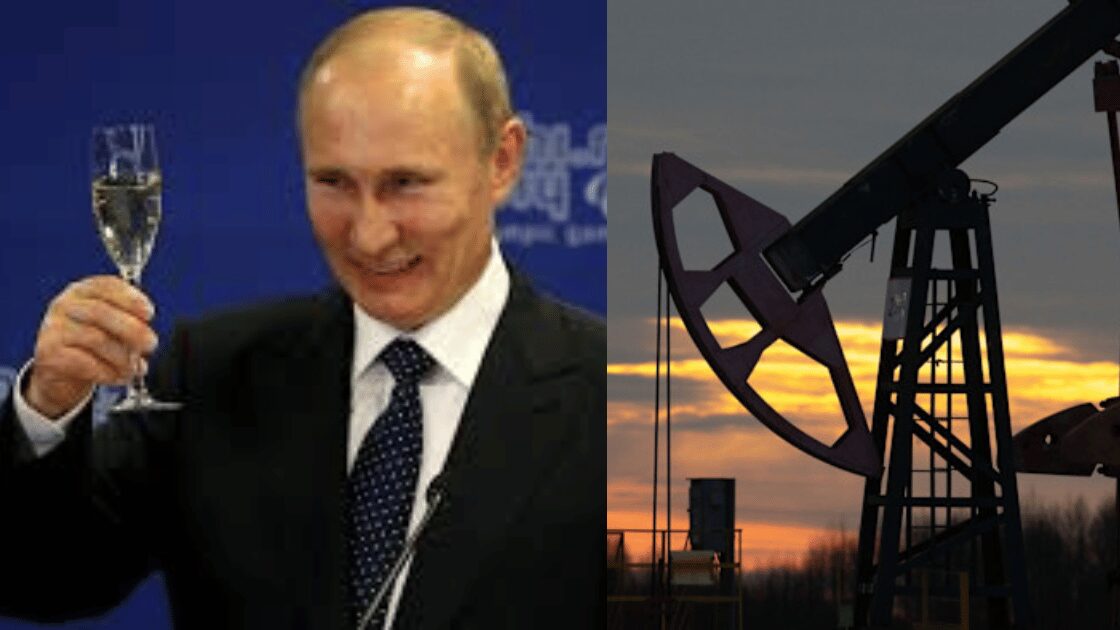
The country the West sanctioned is now the world’s biggest financial beneficiary of a war it didn’t start and Ukraine is paying the price
14th March 2026 | Global Energy Desk
While the United States and Israel wage war against Iran and the rest of the world scrambles to contain soaring fuel costs, one nation is quietly counting its money and that nation is Russia.
In one of the most striking geopolitical ironies of 2026, Vladimir Putin’s Russia — battered by four years of Western sanctions over its invasion of Ukraine, struggling with falling oil revenues and a ballooning budget deficit — has emerged as the single biggest financial winner from the Iran war. And it hasn’t fired a single shot.
The figures speak for themselves. According to industry estimates reported by the Financial Times, Russia is earning up to $150 million a day in additional budget revenues from oil sales during the crisis. CNBC Other analyses put the figure even higher. Russia has been earning 510 million euros — approximately $588 million — every day this month from oil and liquefied natural gas exports, representing a daily revenue from oil sales that is on average 14% higher than in February, according to the Centre for Research on Energy and Clean Air (CREA).
The cumulative effect is breathtaking. Estimates suggest Moscow has already received a windfall of between $1.3 billion and $1.9 billion from oil export taxes since the effective closure of the Strait of Hormuz drove up demand for Russian oil from India and China. According to Financial Times calculations based on industry data and estimates from several analysts, Russia could receive a total of between $3.3 billion and $4.9 billion in additional revenue by the end of March.
From Pariah to Prize: How Russia’s Oil Went From Unwanted to Indispensable
To understand this extraordinary reversal of fortune, one has to understand just how desperate Russia’s energy situation was before the war.
Russia’s 2026 budget is based on an assumed Urals oil price of $59 per barrel. Before the Iran conflict, many analysts warned this assumption was overly optimistic and that weaker oil and gas revenues could push the country into a much larger deficit than the government’s planned 3.8 trillion rubles. Al Jazeera Russia’s own bank, Sberbank, estimated the deficit could spiral to catastrophic levels. Russian crude was being sold at deep discounts, and exports were crumbling.
Then came February 28th. The US-Israeli strikes on Iran and Iran’s subsequent chokehold on the Strait of Hormuz changed everything overnight.
Before the West Asian conflict escalated, Russian oil had been trading at heavy discounts because of sanctions and pressure from the US and its allies. Now that discount has narrowed sharply and Russian crude is trading $20–$30 per barrel above its average over the previous three months.
The Financial Times cited analysts as saying that every $10 rise in the average monthly oil price adds about $2.8 billion to Russian exporters’ revenues, of which roughly $1.63 billion flows to the government through taxes.
India and China Are Fuelling Russia’s War Chest
The mechanism is straightforward. With Gulf oil cut off, Asia’s energy giants needed an alternative supplier — fast. Russia was ready and willing.
The disruption in Gulf exports pushed large Asian importers to look elsewhere for supplies. India and China, which were already the biggest buyers of Russian crude after Western sanctions were imposed in 2022, increased purchases further during the crisis. Analysts tracking shipping flows say imports from Russia by both countries rose about 22% in the week after the strikes on Iran, compared with February averages. India’s purchases alone are now running at roughly 1.5 million barrels per day — about 50% higher than early last month.
The irony deepens further. The Trump administration, desperate to ease surging gasoline prices at home, effectively gave Russia’s oil trade a lifeline. The U.S. temporarily eased some sanctions on Russian oil shipments. U.S. sanctions will not apply for 30 days on deliveries of Russian oil that had been loaded on tankers, giving reluctant purchasers a green light to buy the oil without worrying about running afoul of U.S. sanctions rules. BNN Bloomberg That measure helped to clear the flotilla of idling tankers full of Russian crude.
In other words, Washington — the architect of the Russia sanctions regime — quietly opened the door for Russia to sell more oil, all while fighting a war that is driving those oil prices through the roof.
The windfall is not going into schools or hospitals. According to defence analysts, every dollar of extra oil revenue helps fund Russia’s grinding war against Ukraine.
The additional fossil fuel earnings are enough for Russia to purchase 17,000 Shahed drones every 24 hours at a cost of $35,000 per unit, according to analysis by the Centre for Research on Energy and Clean Air published by German non-profit Urgewald.
The moral dimension has not been lost on Ukraine’s allies. “This is a political choice. Governments can hold the line on sanctions, or they can signal that if energy prices rise high enough, the West will always find a reason to blink. That choice will not just prolong Ukrainian suffering. It will undermine the security of Europe as a whole,” said Alexander Kirk, Sanctions Campaigner at Urgewald.
The current high prices “will help Russia to meet budget indicators this quarter and even start saving some money,” according to Borys Dodonov, Head of the Energy and Climate Research Unit at the Kyiv School of Economics.
The scale of the fiscal rescue cannot be overstated. If oil prices were to stay elevated at $70–$90 for an entire year, Russia exported an average of about 4.8 million barrels of crude per day in 2025. If prices average $70 instead of $59 in 2026, that could bring roughly $20 billion in additional revenue compared with the government’s forecast. At an average price of $90 per barrel, this extra revenue boost could rise to about $55 billion.
Russia is set to be the first big winner from the Middle East war that sent oil prices above $100 a barrel. The gains should soon be reflected in flows to the Kremlin’s war chest after its Black Sea export terminal was repaired following a Ukrainian drone strike. Moscow is benefiting from the double win of soaring prices for global benchmarks, which also lifted Russian export prices, and the additional benefit of a US tariff waiver that allows Indian refiners to buy Russian crude.
Analysts caution that Russia’s windfall may be temporary. The scale of the gains depends entirely on how long the Iran war continues. Analysts caution that this boost to revenue may prove short-lived and is unlikely to fully reverse Russia’s economic woes.
President Trump has suggested the conflict could end “pretty quickly.” Other major powers also have strong incentives to prevent a prolonged shutdown of the Strait of Hormuz. More than 80% of the oil shipped through the passage goes to Asian markets, with China, India, Japan and South Korea among the largest buyers, raising the likelihood that diplomatic or security arrangements will eventually restore shipping through the strait.
Should a ceasefire or deal be struck that reopens the strait and sanctions on Iranian oil are lifted, the reverse could be equally brutal for Moscow: a possible US-Iran deal including the lifting of the embargo on Iranian oil would contribute to tougher competition in the oil market and stabilisation of Brent prices at relatively low levels $60 per barrel or below in 2026.
Read Also: Sierra Leone Raises Diesel Prices as Global Oil Crisis Deepens And Relief Is Not Coming Soon
There is a deeply uncomfortable conclusion at the heart of this story. A war fought in the name of American and Israeli security interests is simultaneously funding Russia’s war against Ukraine through the simple mechanism of rising oil prices and market desperation. While Sierra Leone raises diesel prices and European families face pump prices above €2 per litre, Russia is cashing in at a rate of hundreds of millions of dollars every single day.
Russia, despite its denial of providing alleged assistance to Iran, clearly benefits from the conflict’s continuation, particularly the rise in oil prices.
For Ukraine, for Africa, for Asia’s working poor, and for every motorist watching the pump price tick upward — the Iran war is a catastrophe. For the Kremlin, it is quietly, devastatingly, a gift.