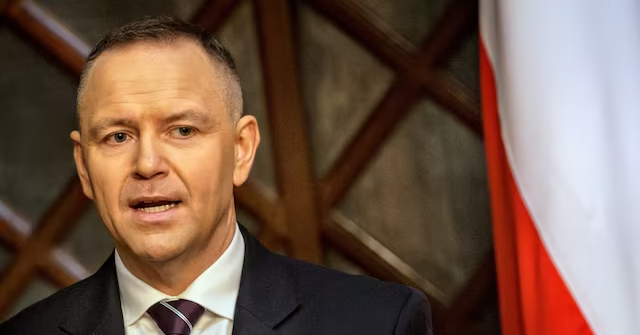
Polish President Karol Nawrocki cut short his journey to Senegal on Friday, October 30, 2026, and returned to Poland following a major dispute over the leadership of the country’s Constitutional Tribunal.
The decision came after Anna Korwin-Piotrowska, the court’s longest-serving judge, announced the suspension of Constitutional Tribunal President Bogdan Swieczkowski, a political ally of the former nationalist Law and Justice government.
According to Reuters, Korwin-Piotrowska declared that she had taken over leadership of the court, escalating an ongoing political confrontation between President Nawrocki and Prime Minister Donald Tusk’s government over judicial independence and control of the judiciary.
Reacting to the development, Nawrocki announced on social media platform X that he was abandoning his trip to Senegal to address the situation at home.
“At a moment like this, the President must be in Poland. I am cutting short my flight to Senegal. I am returning,” he wrote.
The announcement followed protests outside the Constitutional Tribunal, where hundreds of demonstrators gathered under heavy police security. Right-wing politicians addressed the protesters, accusing Tusk’s government of attempting to take control of the court.
Prime Minister Tusk rejected the accusations, maintaining that his administration was working to restore the rule of law following years of controversy surrounding judicial appointments.
The dispute over Poland’s Constitutional Tribunal dates back to 2015, when the Law and Justice Party began appointing judges to positions that had already been filled by the previous government.
The appointments sparked criticism from legal experts and European institutions, which questioned the court’s independence and impartiality.
Since taking office in 2023, Tusk’s coalition government has promised reforms aimed at strengthening judicial independence. However, those efforts have faced resistance from Nawrocki, who became president in 2025.
Earlier in 2026, Nawrocki refused to swear in three of six judges nominated by parliament, while Swieczkowski declined to seat judges selected by the current parliamentary majority.
The latest confrontation has deepened political divisions in Poland and raised fresh concerns about the future of the country’s judicial system.
The dispute also presents a major challenge for Tusk’s government as it seeks to rebuild confidence in Poland’s democratic institutions and relations with the European Union.


