

Freetown, 16 December 2025 — Statistics Sierra Leone (Stats SL) has ended its Pilot Population and Housing Census with a high-level briefing for international Independent Monitors, using the session to take stock of what worked, what didn’t, and what must change before the national headcount planned for 2026.
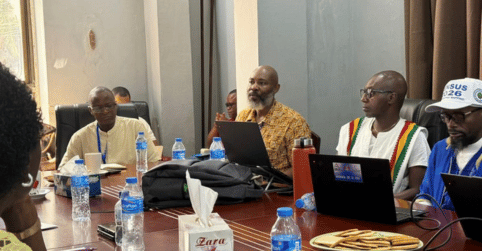
Held at Stats SL’s Conference Hall at Kona Lodge, the briefing brought together senior management of the statistics agency and representatives from regional and international partner institutions, including the United Nations Population Fund (UNFPA), the United Nations Economic Commission for Africa (UNECA), the Mano River Union, and the United Kingdom’s Office for National Statistics. The central purpose was to review observations from monitoring teams, weigh operational risks, and agree on practical recommendations that can be implemented in the remaining preparation window.
Opening the session, Statistician General Andrew Bob Johnny thanked the monitors for what he described as timely technical support and frank feedback, noting that the pilot has effectively created a year-long opportunity to adjust systems and resolve weaknesses before the main exercise. “The value of discussing these observations in person—especially operational and physical issues—cannot be overstated,” he said, while assuring participants that recommendations would be reviewed and acted upon.
From Stats SL’s perspective, three areas have emerged as priorities for improvement ahead of 2026. The first is the need to shorten the census questionnaire so it aligns more closely with international standards and becomes easier to administer efficiently in the field. The second is deeper stakeholder engagement, particularly to ensure disability-related and other Sierra Leone–specific data needs are properly captured and understood before the national rollout. The third is completing the shift from Paper and Pencil Interviewing (PAPI) to Computer-Assisted Personal Interviewing (CAPI), an approach the agency sees as essential for better data quality, faster fieldwork, and more consistent interview durations.
An update on the programme was delivered by Abdulai Salia Brima, Director and National Census Coordinator, who said preparations remain on track despite operational pressures. He traced the present phase to the year 2024 when the plans for the present phase started being made after the validation of the project proposal by UNFPA and the European Commission. Brima also cited the experience gathered during the country’s maiden electronic census in 2021 as the basis for the present strategy and argued that the acceptance level has improved over the years and that the CAPI technology has also undergone significant improvement.
He explained that the pilot census was designed as a stress test rather than a ceremonial rehearsal, focusing on whether systems, applications, and field operations could perform under real conditions. That testing, he said, was carried out in close collaboration with UNFPA and UNECA and was intended to highlight not only technical gaps but also the everyday management issues that can make or break a national enumeration.
The independent monitoring team included Algernon B.C. Johnson of the Mano River Union; Omar C.F. Kebbeh of the Gambia Bureau of Statistics; Tapiwa Jhamba of UNFPA Headquarters, Nairobi; Rachel Shipsey and Garnett Compton of the UK Office for National Statistics; Collins Opiyo of UNFPA Nigeria; and William Muhwava of UNECA.“The feedback has been encouraging on frontline readiness, although it has also highlighted some dangers that, if neglected, could jeopardize the conduct of the 2026 census.”
Positively, the monitors found a great deal of enthusiasm and awareness among field-level officials and the local administration, together with a sound awareness of census goals and procedures. Staffing levels were assessed as adequate in the pilot areas, and the monitors noted clear improvements in the performance of the CAPI tools compared with earlier experiences. They also pointed out that technical challenges were responded to when they arose, which suggests that mechanisms for troubleshooting and support structures are not as fragile as they were.
Other contributions appreciated include the design of the pilot areas themselves. The monitors described the selection as suitably diverse for testing different operational environments, and recommended that in the future, pilots should also include an elite area in Freetown, to ensure the systems and field approach are robust across all socio-economic contexts.
Against these strengths, a number of risks were also brought out in this briefing that need to be addressed. First, there is underutilization of operational data for the management of day-to-day field activities. This undermines the ability of the supervisors to view progress in real time, coverage, and hotspots of problems, leading to inefficiencies that could be avoided. Another risk identified was that of financing. According to the projections made by the monitors, there is an anticipated funding gap of approximately USD 13 million, which, unless closed, might affect recruitment, logistics, training, technology deployment, and pace.
It will also be challenged by the competing demands on time, staff, and systems. The monitors pointed to the potential strain created by concurrent major surveys, including the Multiple Indicator Cluster Survey (MICS) and the Demographic and Health Survey (DHS). With many of the same technical skills and field resources required across these activities, the scheduling and resourcing decisions made in the coming months could determine whether census preparation remains steady or becomes overstretched.
Looking ahead, the Independent Monitors are expected to submit their final reports to UNFPA and Stats SL, after which UNFPA will consolidate the findings into a single report. Stats SL is then expected to respond with action plans, revise census tools and training materials, and convene a data analysis and evaluation workshop to translate lessons from the pilot into concrete adjustments for the national census.
Closing the briefing, Deputy Statistician General Lansana Kanneh thanked the monitors for what he described as an innovation that gives Sierra Leone enough time to improve before the main headcount. He reiterated the agency’s commitment to best practices, inclusivity, and transparency, and emphasized a renewed approach aimed at strengthening national ownership under the principle of “a census by the people and for the people.”
Read Also: TechCabal Honours Minister Salima Monorma Bah for Driving Sierra Leone’s Technology Transformation
The overall tone at the end of the session was optimistic: stakeholders signaled confidence that the pilot’s lessons—both the encouraging signs from the field and the risks now on record—can be used to strengthen systems, close gaps, and deliver a credible, inclusive, high-quality Population and Housing Census in 2026.