

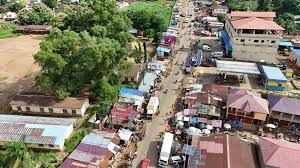
When Sierra Leone’s Chief Justice, His Lordship Honourable Justice Komba Kamanda, received the finalised architectural drawings for the construction of a High Court and three Magistrates’ Courts in Waterloo, the moment marked more than the progression of a building project. It signalled a potential shift in how justice is accessed, delivered and experienced in one of the country’s fastest growing districts.
For decades, the concentration of courts in Freetown has placed immense strain on the justice system. The Law Courts complex in the capital continues to grapple with chronic congestion, characterised by overcrowded courtrooms, repeated adjournments and persistent case backlogs. Legal practitioners estimate that some civil and criminal matters take several years to reach conclusion, a delay that undermines public confidence and weakens the deterrent effect of the law.
Judiciary officials acknowledge that a substantial proportion of cases filed in Freetown originate from Western Rural District, including Waterloo and its surrounding communities. Litigants are routinely required to travel long distances to attend hearings, often at considerable personal cost. Transport fares, lost income and repeated overnight stays in the capital present real barriers to justice, particularly for low income households, women and young people.
The historical absence of a High Court in Waterloo has compounded these difficulties. Despite rapid population growth and expanding economic activity, the district has remained dependent on courts located in Freetown. Legal observers note that this imbalance has effectively placed justice beyond convenient reach for thousands of residents, contributing to delays, case withdrawals and reliance on informal dispute resolution mechanisms that fall outside the formal justice system.
Against this backdrop, the decision to establish a High Court and Magistrates’ Courts in Waterloo represents a structural intervention rather than a symbolic one. Speaking at the handover ceremony held at his chambers in Freetown on 9 January 2026, Chief Justice Kamanda described the development as part of his broader commitment to decentralising judicial services and reducing pressure on the main Law Courts.
He emphasised that justice must not only be guaranteed by law but must also be accessible in practice. By expanding the Judiciary’s physical presence beyond the capital, he said, citizens would be better served and the administration of justice strengthened nationwide.
The architectural drawings were presented by the Chief Director of the Ministry of Works and Public Assets, Engineer Paul Bockarie, who confirmed that the sod turning ceremony is scheduled for 21 January 2026 in Waterloo. He disclosed that the Government of Sierra Leone has contracted Afkam Construction Sierra Leone Limited to execute the project.
While detailed cost estimates were not disclosed at the ceremony, officials from the Ministry of Works indicated that the project is being financed through government capital expenditure allocations. The contractor has assured stakeholders that construction is expected to be completed within twelve months, although analysts caution that infrastructure projects of this scale often face risks related to procurement delays, weather conditions and budgetary pressures.
Engineer Bockarie also provided updates on similar judicial infrastructure projects, noting that procurement for the York Magistrates’ Court has been completed, while construction works are ongoing in Kambia, Kabala, Port Loko and Mongo. These initiatives form part of a broader effort to address long standing deficits in judicial infrastructure across the country.
Providing technical details of the Waterloo complex, the contractor, Mr Abdul F. Kanu, said the facilities will include standard exhibit rooms, specialised courtrooms for juvenile and sexual offences cases, a security post, a borehole to ensure consistent water supply and a car park to support court operations. Site clearance, he confirmed, has already commenced.
Legal practitioners in Waterloo have welcomed the development. A practising lawyer based in the district described the project as long overdue, noting that proximity to courts would reduce delays, lower costs for litigants and improve case management. Civil society actors have also highlighted the importance of specialised courtrooms for juvenile and sexual offences cases, arguing that dedicated facilities can improve the handling of sensitive matters and protect the dignity and safety of victims.
Community leaders believe the courts will have wider social and economic effects. Beyond improving access to justice, they argue that the presence of judicial institutions can stimulate local economic activity through increased demand for accommodation, transport services, legal support staff and small businesses that serve court users.
From a constitutional perspective, the project directly advances the guarantees enshrined in the 1991 Constitution of Sierra Leone, particularly the right to fair hearing within a reasonable time and equal access to justice before the law. Legal scholars have long argued that geographic barriers undermine these rights in practice. By situating courts closer to the people, the Waterloo project helps bridge the gap between constitutional promise and lived reality.
The initiative also aligns closely with the recommendations of Sierra Leone’s Truth and Reconciliation Commission, which identified weak judicial access and institutional exclusion as contributing factors to conflict and social grievance. The TRC called for the decentralisation of justice, improved court infrastructure and stronger protection for vulnerable groups as essential measures for post conflict healing and national cohesion. Observers note that the inclusion of juvenile and sexual offences courtrooms in the Waterloo design directly reflects those recommendations.
From a comparative perspective, Sierra Leone’s move mirrors regional and international trends. In Ghana, sustained investment in decentralised High Courts and Circuit Courts has significantly improved court access per capita. Liberia, while still rebuilding its justice sector, has also prioritised magisterial courts outside Monrovia as part of post war reform. Sierra Leone continues to trail these countries in court density relative to population, making the Waterloo project a necessary corrective step.
Within the wider Commonwealth, decentralised judicial infrastructure is considered a cornerstone of rule of law reform. Commonwealth standards emphasise timely access, geographic equity and adequate facilities as prerequisites for justice delivery. Similarly, African Union justice frameworks encourage member states to strengthen sub national courts to rebuild public trust.
At the international level, the project supports the United Nations Sustainable Development Goal 16, which calls for equal access to justice for all, and aligns with ECOWAS governance protocols that link judicial accessibility to peace, stability and economic integration.
For Sierra Leone, the Waterloo courts project will serve as a test case. Its success will depend not only on construction timelines but also on staffing, resourcing and sustained oversight once the courts become operational. The Judiciary’s ability to translate infrastructure into effective service delivery will determine whether constitutional and post conflict justice commitments are fully realised.
As the sod turning ceremony approaches, expectations are high. For residents of Waterloo and the wider Western Rural District, the project represents the possibility that justice will no longer require a journey to the capital, but will instead be available closer to home.
In a country where delayed justice has too often amounted to denied justice, the construction of courts in Waterloo carries significance well beyond bricks and mortar.
REFERENCES
Judiciary of Sierra Leone
Ministry of Works and Public Assets, Sierra Leone
Ministry of Finance, Sierra Leone
1991 Constitution of Sierra Leone
https://www.sierra-leone.org/Laws/constitution1991.pdf
Truth and Reconciliation Commission of Sierra Leone Report
https://www.sierraleonetrc.org
African Union Commission, Justice and Legal Affairs
United Nations Sustainable Development Goal 16
https://sdgs.un.org/goals/goal16
ECOWAS Governance and Justice Frameworks
Commonwealth Secretariat, Rule of Law and Judicial Reform
World Bank Governance and Justice Indicators
Afrobarometer, Access to Justice and Rule of Law Data