

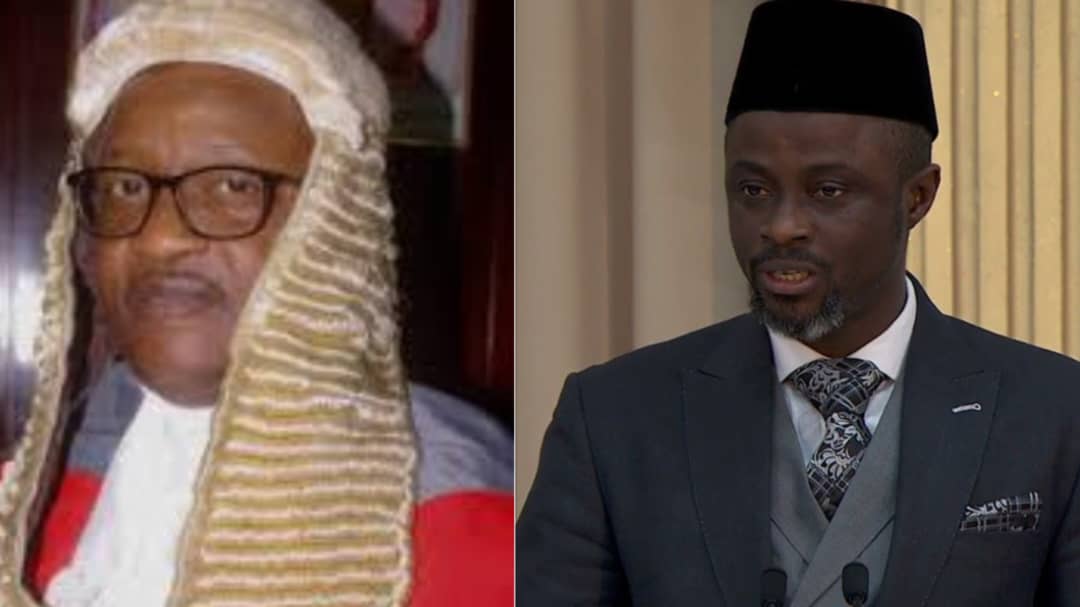
In the quiet corridors of judicial power, the most consequential changes rarely announce themselves with fanfare. They unfold instead through tone, temperament, and the slow recalibration of institutions long burdened by strain. For a Chief Justice assuming office in such circumstances, the first year is less a performance than a test of stewardship, watched closely not for dramatic declarations, but for the subtle signals that reveal intent, discipline, and direction.It is against this backdrop of restrained expectation that the leadership of the Honourable Chief Justice Komba Kamanda is now being measured, one year after his elevation to Sierra Leone’s highest judicial office. Among those offering a considered professional reflection is Musa Mewa, Esq., Head of Chambers at Brewah and Co. and Amir of the Ahmadiyya Muslim Mission in Sierra Leone, whose goodwill message provides a rare practitioner’s window into how early judicial leadership is being perceived within the legal community.Chief Justice Kamanda was appointed by President Julius Maada Bio on 16 December 2024, in accordance with constitutional provisions governing judicial appointments and subject to parliamentary approval. His assumption of office came at a moment when public confidence in state institutions, particularly the judiciary, required careful restoration through credibility, restraint, and demonstrable administrative competence.Constitutionally, the office of Chief Justice in Sierra Leone is both judicial and administrative in character. Under the Constitution, the Chief Justice serves as the head of the Judiciary and chairs key institutional mechanisms responsible for judicial discipline and administration, working alongside the Judicial and Legal Service Commission in matters of appointment, promotion, and oversight. This framework is designed to safeguard judicial independence while ensuring institutional accountability, and it situates the Chief Justice not as a solitary reformer but as a constitutional steward operating within clearly defined legal limits.Mewa’s reflections are not advanced as journalistic commentary, nor are they presented as institutional advocacy. Rather, they constitute the professional impressions of a senior legal practitioner, grounded in observable developments within the judiciary. His goodwill message therefore functions as a practitioner’s checkpoint, offering insight into early administrative direction rather than a definitive verdict on judicial reform.A central theme in Mewa’s message is the apparent preference for administrative substance over rhetorical reformism. He points to a leadership style informed by deep knowledge of the law and an approachable professional disposition, with reform driven less by public pronouncements and more by tangible institutional action. This approach, he suggests, reflects an effort to address long standing but often undocumented institutional weaknesses within the justice sector through steady and deliberate administrative recalibration.Chief Justice Kamanda’s leadership posture is shaped by a career that has traversed every level of the superior courts. Described by Mewa as a vibrant and seasoned bencher, Kamanda rose through the Magistracy, served as a High Court Judge from 2016, and was appointed a Justice of the Court of Appeal in 2020 before assuming the office of Chief Justice. This progression, rooted in sustained courtroom and appellate experience, informs the administrative pragmatism that characterises his first year in office.Within that period, Chief Justice Kamanda oversaw the appointment of thirteen Magistrates, seven High Court Judges, and three promotions to the Court of Appeal and the Supreme Court, acting through constitutionally established processes and advisory bodies. According to Mewa, these appointments have revitalised Magistrate and High Court sittings in remote and previously underserved parts of the country. For a justice system long criticised for its Freetown centric orientation, this development represents a deliberate attempt to address historical imbalances in access to justice and judicial presence.Mewa further draws attention to a Judiciary press release announcing that the Court of Appeal would now sit in provincial and regional headquarter towns. The announcement generated significant public discussion, including commentary on platforms associated with the Sierra Leone Association of Journalists. Historically, appeals were filed and heard almost exclusively in Freetown, a requirement that effectively denied many citizens access to appellate justice due to financial and geographic barriers. In Mewa’s assessment, the extension of appellate jurisdiction to the provinces constitutes an unprecedented expansion of judicial reach and affirms access to justice as an inalienable constitutional right of all Sierra Leoneans.Judicial appointments and promotions, while essential to addressing capacity constraints, remain among the most sensitive aspects of judicial leadership. Mewa’s goodwill message confines itself to acknowledging the scale and immediate impact of recent appointments. Independent professional analysis, however, underscores that institutional legitimacy in this area is sustained not only through merit based selection but also through transparency, procedural fairness, and publicly understood criteria. These considerations form part of the broader evaluative context within which early administrative actions are assessed, particularly in societies where public trust in institutions has been historically fragile.Viewed within a wider comparative context, the administrative focus identified in Mewa’s reflections mirrors reform trajectories observed in peer Commonwealth jurisdictions. Ghana’s judiciary has prioritised decentralisation and internal efficiency as foundations for public trust. Kenya’s post constitutional reform experience illustrates the importance of strengthening lower courts while reinforcing institutional accountability. In the United Kingdom, judicial leadership has long emphasised continuity, managerial competence, and institutional independence, supported by regular public reporting. Against these benchmarks, the early signals emerging from Sierra Leone during Chief Justice Kamanda’s first year suggest broad alignment with established Commonwealth norms.Importantly, these administrative measures also reflect the stated vision of the Judiciary of Sierra Leone, which emphasises a credible, fair, and expeditious justice system for all. This alignment reinforces the view that recent reforms are institutional rather than personality driven, and that they form part of a broader continuity within the judicial framework rather than a departure from it.At the same time, a balanced assessment requires acknowledgement of persisting public scepticism and critical commentary. Some court users and civil society observers note that delays remain in certain jurisdictions, that infrastructural limitations continue to affect court efficiency, and that decentralisation alone does not automatically resolve systemic bottlenecks. These concerns do not negate the administrative strides recorded, but they underscore the reality that reform within complex judicial systems is cumulative rather than instantaneous, and that progress must be sustained to be meaningful.While Musa Mewa’s goodwill reflections are confined to observable administrative achievements, broader journalistic assessment and independent professional commentary indicate that Chief Justice Kamanda’s leadership is unfolding within enduring structural constraints. These include limited funding, inherited case backlogs, infrastructural deficits, and legislative inertia that slows procedural reform. Observers within the legal community, both domestically and internationally, note that the Chief Justice appears attentive to these realities and approaches public evaluation with measured caution, balancing optimism with institutional limitation.Within this wider analytical frame, leadership tone, judicial culture, and early institutional direction, though encouraging, can only be meaningfully assessed against the practical outcomes experienced by ordinary citizens in their pursuit of justice. Early administrative adjustments, implemented gradually and deliberately, are widely understood as part of a broader effort to restore public confidence in the judiciary rather than as an end in themselves.By way of independent illustration, a magistrate in Kailahun has reported that the restoration of local High Court sittings has contributed to an estimated thirty per cent reduction in case adjournments, enabling families and businesses to resolve disputes with greater efficiency. Such micro level indicators, while not part of Mewa’s goodwill message, suggest that recent administrative reforms are beginning to translate into tangible improvements in everyday judicial experience.Crucially, judicial leadership does not operate in isolation from the wider socio political environment. Persistent public scepticism towards state institutions, fiscal pressures, and legislative inertia continue to shape the judiciary’s operating space. Legal analysts within Sierra Leone and beyond caution that acknowledging these constraints is essential to avoiding both uncritical praise and undue censure. This perspective reinforces the importance of sustained and measured evaluation over time, rather than premature conclusions drawn from early reform signals.Taken together, Musa Mewa’s reflections function as a professional checkpoint rather than a personal endorsement. They convey cautious confidence rather than triumphalism, acknowledging early administrative gains while implicitly recognising that structural reform is neither immediate nor guaranteed. This restraint enhances the credibility of the goodwill message and strengthens its value as a serious professional assessment.One year is insufficient to render a definitive judgement on any Chief Justice. It is, however, sufficient to observe leadership posture, administrative intent, and early institutional direction. On these measures, the impressions shared suggest a judiciary in a phase of careful recalibration rather than dramatic overhaul. Whether these early signals mature into lasting reform will depend on sustained independence, consistent resourcing, legislative support, and above all the lived experience of justice for ordinary Sierra Leoneans across all regions.Musa Mewa’s message exemplifies high calibre professional assessment. While he is not a practising journalist, his reflections are fair, balanced, and grounded in verifiable developments. They reaffirm a central truth of judicial leadership in democratic societies: that reform is less a moment of command than a discipline of stewardship, measured not by declaration but by durability. For Sierra Leone, the first year of Chief Justice Komba Kamanda offers both reason for cautious optimism and a responsible framework through which future judicial progress may be judged.