

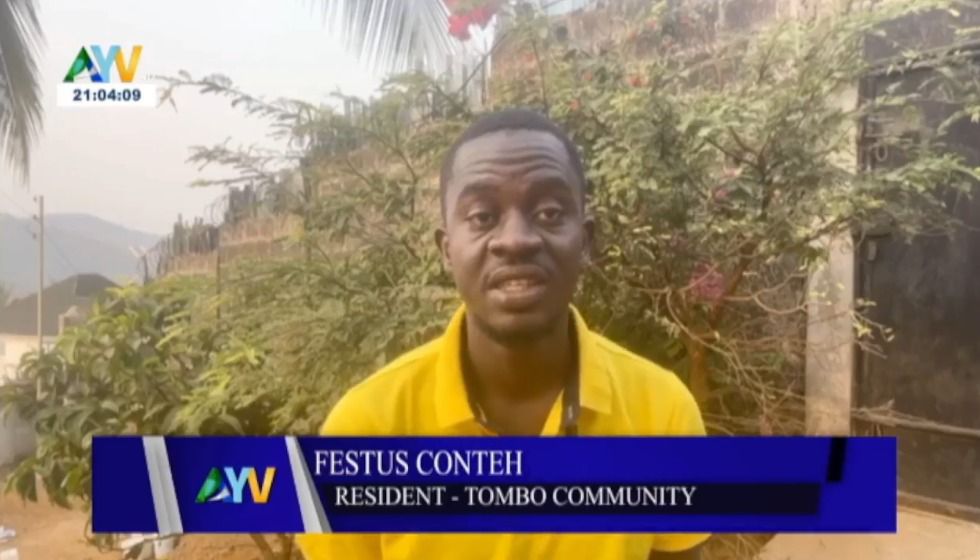
Yesterday, Festus Conteh, a third-year Mass Communication student of Fourah Bay College and a resident of Tombo, appeared on AYV Prime Time News to speak on the growing hardship facing fishing communities following the one-month closure of all sea activities.
Festus has emerged in recent weeks as one of the most consistent voices drawing attention to the impact of the closed season on Tombo. Through his social media platforms and now national television, he has been speaking plainly about a reality many outside the community rarely see.
On AYV, he described Tombo not just as a coastal town, but as a place whose entire existence is tied to the sea.
“Tombo is a town built entirely around the sea. Fishing is not just an occupation here, it is the economy, the culture, and the survival system. Almost every household depends directly or indirectly on daily fishing activities. When boats go out, money comes in. That money pays for food, school fees, transport, and medical care. There are no factories, no farms large enough to absorb people, and no alternative industries. What is earned in the morning is what is eaten in the evening. So when people say Tombo survives by the sea, it is not a figure of speech. It is a literal description of how life works here.”
He went on to explain how the closed season has already begun to reshape daily life in painful ways.
“The closed season has already created fear and uncertainty, and now that it has started, it is creating real hardship. For many families, this means a full month with no income and no support system to fall back on. Meals will be reduced. Children may be sent home from school. Medical needs will be postponed.”
Festus noted that some fishermen have started leaving Sierra Leone in search of survival, heading to neighboring countries such as Guinea and Liberia, while those who cannot afford to travel are left to endure hunger at home.
Importantly, he made it clear that resistance is not against conservation itself.
“People are not against conservation. Fishermen understand the sea better than anyone. But conservation without economic relief becomes punishment for the most vulnerable.”
He warned that the consequences of the closure, if not properly managed, would go beyond economics.
“The impact of this closed season, if not properly managed, will not only be economic. It will be social, emotional, and deeply human. It will test how a town that depends only on the sea is expected to live when the sea is taken away, even temporarily.”
Festus Conteh is expected to continue the conversation on Truth Media, where he will be featured again on Truth Ivnin Tok, live at 8:00 p.m. More media appearances are also planned in the coming week as he continues to speak on behalf of a community struggling to be heard.
For Tombo, his message remains simple and urgent: conservation must go hand in hand with compassion, support, and realistic solutions for the people whose lives depend on the sea.