
The government of Burkina Faso has issued a furious rejection of a landmark report by the international rights organization Human Rights Watch (HRW), dismissing it as a fabricated document driven by neo-colonial and imperialist agendas as the world’s most detailed account yet of civilian mass killings in the war-ravaged West African nation sent shockwaves across the global human rights community.
Released on April 2, 2026, the 316-page HRW report titled “None Can Run Away”: War Crimes and Crimes Against Humanity in Burkina Faso by All Sides found that the Burkina Faso military with its allied militias and an Al-Qaeda-linked armed group have killed more than 1,800 civilians and forcibly displaced tens of thousands since 2023. HRW said the atrocities, including the government’s ethnic cleansing of Fulani civilians, amount to war crimes and crimes against humanity for which senior leaders on all sides may be liable.
The government’s response was swift, sweeping and unequivocal.
In an official communiqué issued on April 5, Government Spokesperson Pingdwendé Gilbert Ouédraogo dismissed the report in its entirety, describing it as a work of fiction engineered by hostile external forces.
The government stated it had taken note of what it called “a false report” published by HRW, describing the document which covers the period 2023 to 2025 as “a tissue of conjectures and baseless grave allegations for which Human Rights Watch is well known.”
The communiqué went further, questioning HRW’s very legitimacy to report on Burkina Faso, noting that the organisation has no office or official representation in the country. It accused HRW of “regularly relaying allegations from selected individuals who receive subsidies from it in exchange for feeding its imaginary and fantastical narratives.” The government described the report as the condensed expression of “visceral hatred” by a “coalition of dark forces” against Burkina Faso’s struggle for sovereignty and freedom.
Most strikingly, the government framed HRW not as a human rights watchdog but as an instrument of neo-colonial interference. The communiqué accused the organisation of seeking to impute the responsibility for “massacres, rapes, looting, killings and heinous crimes” to the country’s armed forces and Volunteers for the Defence of the Homeland crimes it insisted were actually perpetrated by jihadist groups and their external backers. The government reserved the right, it warned, “to take firm measures against all imperialist agencies disguised as NGOs.”
The sweeping government rejection stands in sharp contrast to the painstaking methodology HRW says underpins its findings.
The report is based on a total of 450 interviews including with 380 victims of abuses conducted by Human Rights Watch between March 2023 and February 2026, remotely and in person in Burkina Faso, Benin, Côte d’Ivoire, Ghana, and Mali. The report also draws from the verification and analysis of photographs, videos, satellite imagery, and documents, as well as social media content and official reports.
According to the findings, state security forces and allied militia groups known as the Volunteers for the Defence of the Homeland (VDP) were responsible for the majority of civilian deaths, accounting for 1,255 fatalities more than double the number attributed to insurgent groups. The report also accuses government forces of carrying out systematic ethnic cleansing against the Fulani community, broadly accused by authorities of supporting Islamist militants.
HRW said at least 1,255 civilians were killed in 33 incidents carried out by the military and VDP between January 2023 and April 2025, while the Al-Qaeda-linked JNIM was responsible for at least 582 deaths in 24 attacks during the same period.
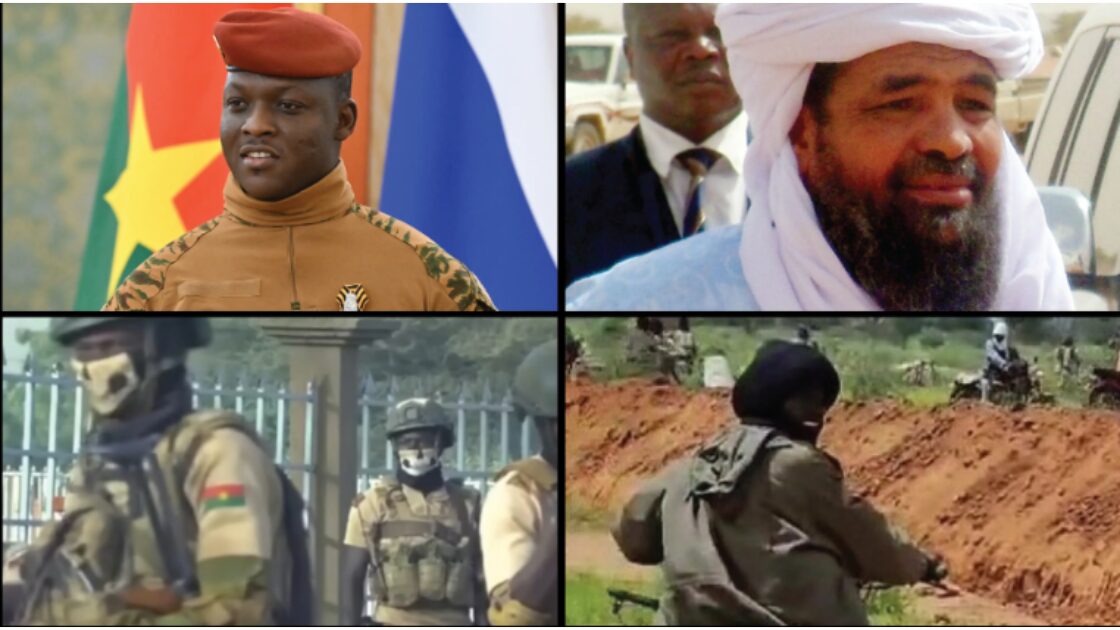
The report documents 57 incidents involving Burkinabè military forces and allied militias, as well as the Islamist armed group JNIM. It names President Ibrahim Traoré and six senior Burkinabè military leaders who may be responsible as a matter of command responsibility for the abuses documented, as well as JNIM’s supreme leader Iyad Ag Ghaly and four other JNIM leaders.
Among the most devastating single incidents documented, the military and allied militias allegedly killed more than 400 civilians during an operation in the northern town of Djibo in December 2023, with survivors describing a scene of systematic execution and absolute brutality.
Jean-Baptiste Gallopin, senior advisor for the Crisis and Conflict Division at HRW, said government forces and VDP militias were committing ethnic cleansing against the Fulani population. “The victims are not in a position to file complaints and obtain justice in Burkina Faso because they are terrorised,” he told RFI. “They have no confidence in the judicial system. And in some cases, families of victims who filed complaints were not only threatened, but even the magistrates investigating the cases suffered reprisals.”
Binta Sidibé-Gascon, president of the Kisal Observatory, a Sahel-based human rights monitoring group, praised the report. “This documentation is essential for the families, the victims and the survivors. All these human rights violations have been recurring in recent years, but they have also intensified with the arrival of military regimes,” she said. “Our hope today is that we can go beyond documentation that is, truly bring all these emblematic cases to justice.”
HRW urged the Office of the Prosecutor of the International Criminal Court to open a preliminary examination into alleged war crimes and crimes against humanity committed by all parties to the conflict since September 2022.
The timing of that call is significant. Burkina Faso has formally announced its intent to withdraw from the International Criminal Court a move that coincides with new domestic legislation further restricting civil liberties, including the dissolution of the Independent National Electoral Commission.
In September 2025, Burkina Faso announced it would leave the ICC, jeopardising access to justice for victims of atrocity crimes. The country also left the Economic Community of West African States (ECOWAS), limiting opportunities for citizens to seek justice through the ECOWAS Community Court of Justice.
This is not the first time Ouagadougou has rejected an HRW report. The junta has consistently responded to international human rights documentation with flat denials and counter-accusations. In February 2026, HRW had also reported that the junta had further restricted political activity and civil liberties, effectively “pulling the plug on political life” amid worsening insecurity.
As of early 2026, over 4.5 million people are currently in need of humanitarian aid in Burkina Faso, while 30% of the country remains outside of state control.
Read Also: Traoré Tells Burkina Faso to “Forget Democracy” — Three Months After Banning All Political Parties
The government of Ibrahim Traoré which has banned political parties, dissolved the electoral commission, expelled French forces, suppressed the media, forcibly conscripted journalists and critics into front-line military service, and rejected democracy itself as a concept now faces the most comprehensive human rights indictment of its tenure. Its response, characteristically, is to shoot the messenger.
Whether the international community will treat that response as credible or as one more data point in a widening pattern of impunity may determine not only Burkina Faso’s fate but also the course of accountability across the entire Sahel.