

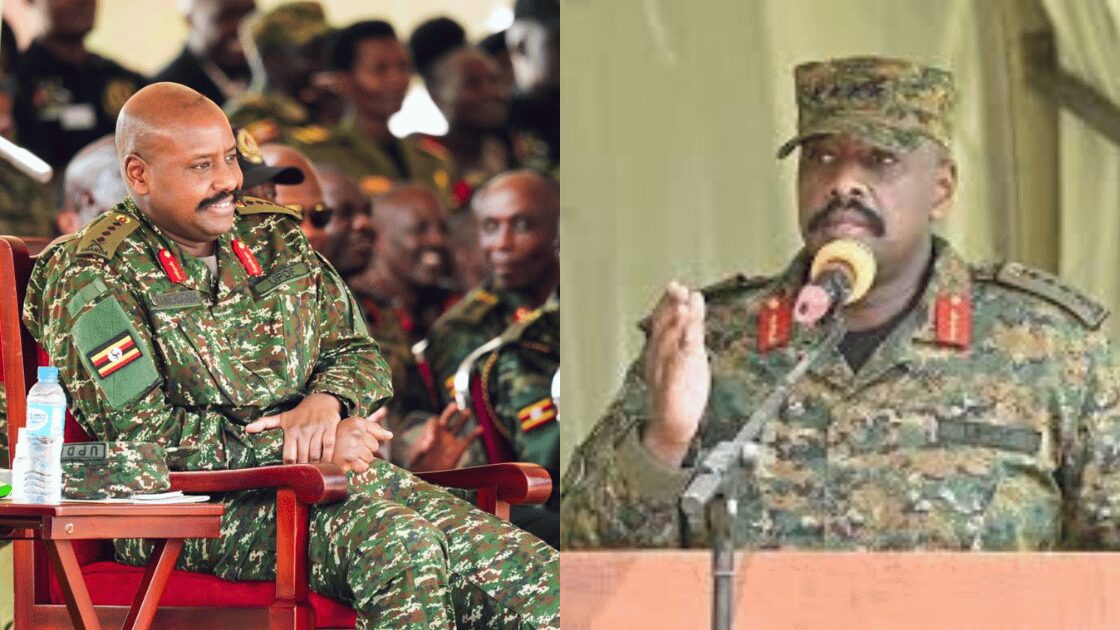
It was Valentine’s Day. Couples across the world were on bended knee, roses in hand, rings in pocket. And Uganda’s Chief of Defence Forces General Muhoozi Kainerugaba, son of President Yoweri Museveni, one of East Africa’s most powerful and unpredictable public figures was on social media, watching it all with barely concealed contempt.
In a statement posted on February 14, 2026, Muhoozi criticised the tradition of kneeling to propose marriage, dismissing it as unnecessary and foreign: “And this Kizungu nonsense of kneeling down to a woman to ask her to marry you… that’s rubbish. We shall start arresting men who do that!” he wrote. “If you are a Ugandan and kneel down for a woman for anything, you are going to jail. You can survive if you say you are Congolese or Nigerian or something,” he added.
The post detonated immediately. By nightfall on Valentine’s Day, Muhoozi’s remarks had been screenshotted, shared, quote-tweeted, mocked, defended, and debated by millions of people across Uganda, East Africa, and far beyond — triggering one of the most spirited online cultural conversations the continent had seen in months.
And that was just the beginning.
To understand why a social media post about kneeling instantly became continental news, one must understand who Muhoozi Kainerugaba is and what his unusual public profile represents in Uganda’s political and military landscape.
General Muhoozi Kainerugaba is Uganda’s Chief of Defence Forces and son of President Yoweri Museveni a combination that makes him simultaneously one of the most powerful military figures in East Africa and one of the most watched social media personalities on the continent. His reputation for unfiltered online statements has grown steadily over the years, generating widespread discussion and occasional backlash across the region.
Muhoozi has used his X account followed by hundreds of thousands across Africa to declare his love for Beyoncé, express geopolitical opinions that have created diplomatic incidents with neighbouring Kenya, weigh in on the Russia-Ukraine war, and offer an apparently endless stream of cultural commentary that sits somewhere between genuine conviction and deliberate provocation.
The kneeling post was part of a remarkable Valentine’s Day output. In the same period, Muhoozi stated that women wearing red dresses in Kampala could face arrest in the future, linking their choice of colour to suspected communist sympathies. Days later, he suggested that Ugandans who marry women he found physically unattractive should be fined and forced to pay a penalty to the Uganda Revenue Authority.
Whether these statements reflect genuine policy ambitions or are the calculated social media strategy of a man who understands that controversy generates attention or both they have made Muhoozi impossible to ignore. And the kneeling proposal post was his most viral yet.
Muhoozi’s post was not an abstract cultural observation. It was triggered by a specific photograph and the individual in that photograph quickly became a central character in the story.
The exchange began when Muhoozi shared a photograph taken in June 2025 showing popular Ugandan singer Ykee Benda down on one knee, proposing to his partner, Emilly Nyawira. In his caption, Muhoozi dismissed the act as “nonsense” and suggested that men who kneeled to propose should be arrested. Benda, rather than responding with outrage, chose a different approach responding in a light-hearted tone, implying that for a generous payout he would be willing to stage the proposal again, this time “the right way.” “My leader @mkainerugaba I am willing to redo this proposal the right way,” Benda wrote.
The exchange between the general and the singer one deadly serious, one cheerfully mercenary perfectly encapsulated the comic and serious dimensions of the debate simultaneously. Benda’s fans were less amused, however, with many criticising him for appearing to capitulate to or trivialise a statement they found genuinely concerning.
Strip away the bluster and the threat of arrest which has no basis in Ugandan law and reflects no official government policy and there is a genuine cultural argument embedded in Muhoozi’s post that resonates with many Africans, whatever they think of the messenger.
Muhoozi argued that the practice is not African labelling kneeling proposals “Kizungu,” a Swahili term meaning “European” or “Western,” used colloquially to describe cultural practices imported from the West. The argument is one that has been made, in various forms, by cultural commentators, traditional leaders, and social critics across the continent for years: that the global spread of Hollywood romantic tropes the ring box, the kneeling proposal, the Valentine’s Day grand gesture represents a form of cultural colonialism that supplants indigenous courtship traditions with foreign ones.
In Uganda’s own cultural context, traditional marriage processes involving introductions, negotiations between families, bride price arrangements, and community rituals are rich, elaborate, and deeply meaningful. The one-knee proposal is, in that context, genuinely foreign: an American movie convention that spread globally through television and social media and has been adopted sometimes alongside, sometimes instead of, traditional practices by younger urban Africans.
The question of whether adopting elements of other cultures’ romantic expression is colonialism or simply human cultural exchange is one that does not have a clean answer. But it is a real question and Muhoozi, whatever his motivations, put it at the centre of millions of conversations.
The online response to Muhoozi’s post divided broadly into three camps.
The first and loudest was straightforward mockery. The image of Uganda’s Chief of Defence Forces personally monitoring kneeling proposals and dispatching military units to wedding venues to arrest lovestruck men quickly became meme material across East Africa. The absurdist comedy practically wrote itself.
The second response was more serious pushback from women and gender advocates who pointed out that embedded in Muhoozi’s framing the idea that kneeling “for a woman” is somehow shameful or degrading for a man is a deeply patriarchal assumption: that a man expressing vulnerability, reverence, or romantic submission is doing something unmanly and therefore worthy of state punishment.
The third response was genuine cultural agreement particularly from older Ugandans and those with strong attachments to traditional values, who found in Muhoozi’s words an expression of something they had felt for years: that imported romantic conventions were displacing more meaningful indigenous practices, and that nobody in public life was willing to say so plainly.
All three responses are worth taking seriously. The mockery is justified threatening arrest for a marriage proposal is, on its face, absurd. The feminist critique is correct the discomfort with male vulnerability expressed in the post has a troubling gender politics dimension. And the cultural concern is real the globalisation of Western romantic norms is a genuine phenomenon worth examining honestly.
This was not, by any measure, Muhoozi Kainerugaba’s most controversial social media moment merely his most globally shared one on the subject of romance.
His X account has previously generated diplomatic incidents with neighbouring Kenya, after he posted that Uganda’s military could take Nairobi in two weeks a statement that required formal diplomatic de-escalation at the highest levels between the two countries. He has weighed in on the Russia-Ukraine war with pro-Russian sentiments that placed Uganda in an uncomfortable international spotlight. He has made statements about Beyoncé that are charitably eccentric from a Chief of Defence Forces.
This latest outburst adds to Muhoozi’s reputation for unfiltered online statements that often generate widespread discussion and occasional backlash in the region.
The pattern raises a question that Ugandans across the political spectrum have been asking for years: what is the appropriate relationship between Uganda’s Chief of Defence Forces and his very public, very opinionated, very online personal brand? In most countries, the head of the armed forces operates with a degree of institutional discipline that constrains public commentary to official statements. In Uganda, the Chief of Defence Forces uses his social media account to threaten to arrest men who kneel.
Whether that represents the freedom of expression of a self-confident public figure, a calculated strategy to maintain relevance and cultivate a populist following, or simply the behaviour of someone who faces no institutional consequences for anything he says — is a matter of active debate in Kampala.
For anyone genuinely alarmed by the prospect of Ugandan soldiers stationed outside jewellery stores awaiting kneeling proposals, the legal reality provides reassurance.
There is no law in Uganda or anywhere on the African continent that prohibits men from kneeling during marriage proposals. Muhoozi’s post does not reflect official government policy. The Ugandan government has not issued any statement endorsing, clarifying, or distancing itself from the remarks. The Uganda Police Force has not announced any operations targeting romantic gestures.
The comments are the personal opinion of a powerful individual with a very large social media following and in a country where that individual is also the son of the sitting president and the head of the armed forces, the line between personal opinion and institutional signal is blurry enough to make the statement unsettling even without any basis in law.
That blurriness between Muhoozi the private citizen commentator and Muhoozi the Chief of Defence Forces is itself the most significant thing his kneeling proposal post revealed. Not about African culture. Not about Western romantic conventions. About power, accountability, and who gets to say outrageous things without consequence.
Beyond the specifics of Uganda and beyond the particular provocations of Muhoozi Kainerugaba, the debate his post ignited touches something real and important across the African continent.
Younger generations of Africans are navigating a complex cultural landscape deeply proud of their heritage, deeply connected to global culture through the internet and social media, and often living in the creative tension between the two. The question of which elements of Western culture to embrace, which to adapt, and which to reject is one that plays out daily in fashion, music, religion, language, and yes in how people express love to each other.
Read Also: Uganda Extends Polling Hours After Voting Delays Amid Technical Problems
That question deserves a genuine, nuanced, community-led conversation not a general’s threat to deploy state power against men who bend one knee in the direction of someone they love.
But Muhoozi Kainerugaba has, whatever his intentions, started that conversation. Millions of Africans are having it today. And in that very specific, very unintended sense, a man who wanted to assert the authority of tradition has inadvertently produced something quite modern: a continent-wide debate, conducted in real time, about who gets to define African identity — and whether a man in uniform on social media is the right person to do it.