
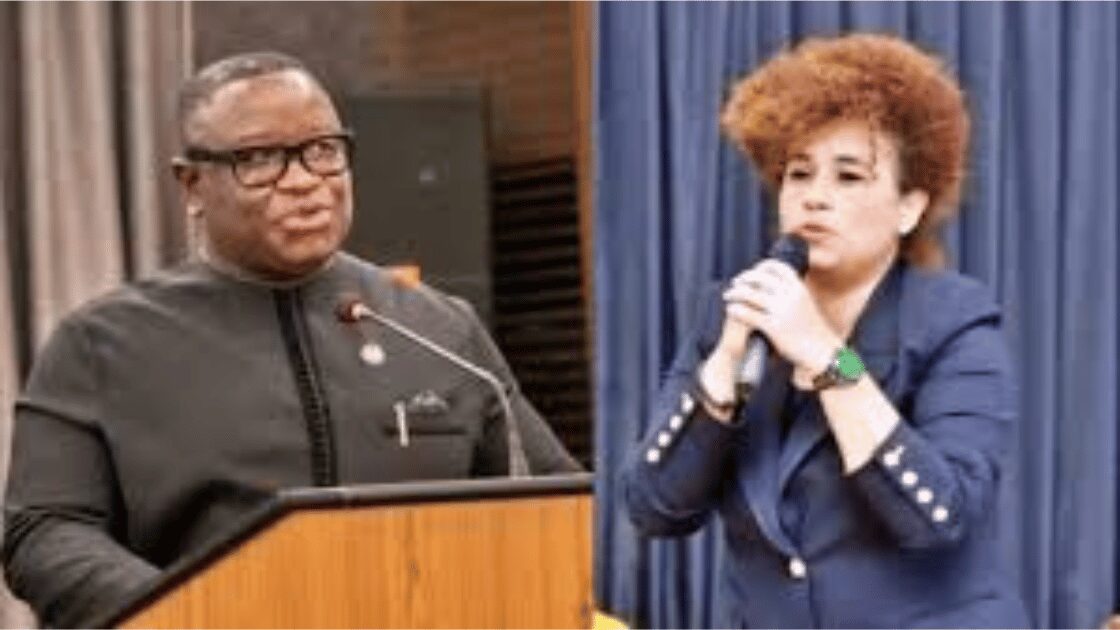
As the government rolls out subsidies and assurances, one of Sierra Leone’s most prominent human rights lawyers asks the question ordinary citizens are too afraid to ask who is making a sacrifice at the top?
The words were brief. Measured. Respectful, even. But they carried the full weight of what hundreds of thousands of Sierra Leoneans are feeling as the price of fuel rises, again, and the motorcades of power roll on, unaffected.
“The temporary steps taken by the government to cushion rising fuel costs are commendable,” wrote Lawyer Basita Michael in a post that quickly circulated on social media. “But convoys observed to run into over 20 SUVs send the wrong message at a time like this. Respectfully, easing the burden must begin at State House.”
Eleven sentences. One indictment.
Sierra Leone is in the grip of a fuel price crisis that has tightened, month by month, throughout the first quarter of 2026. On March 6, the government, through the Ministry of Information and Civic Education and the National Petroleum Regulatory Authority (NPRA), announced that petrol pump prices had increased from NLe28.50 to NLe32.00 per litre. That adjustment, the government insisted, was unavoidable a product of global forces beyond Freetown’s control.
By March 14, the government announced a further increase: petrol held at NLe32 per litre while diesel rose to NLe35 per litre, following a meeting between government officials and oil marketing companies to review the global fuel market.
It did not stop there. On April 2, 2026, the Ministry of Information and Civic Education announced yet another increase, setting fuel prices at NLe35 per litre for petrol and NLe40 per litre for diesel, effective through April 15. To mitigate the impact, the government announced it would subsidise NLe1.10 per litre on petrol and NLe4.26 per litre on diesel during the period.
The government points out that the subsidy represents real sacrifice that without government intervention, the pricing formula could have pushed petrol to NLe36.10 per litre and diesel to NLe44.26 per litre. Officials have also been careful to explain the structural realities underpinning these increases. The NPRA Director General, Brima Baluwa Koroma, has clarified that Sierra Leone imports refined petroleum products rather than crude oil, meaning that freight charges, commercial levies, insurance costs, and other logistical expenses significantly influence the final price paid at the pump.
The Platts Rate the international benchmark used to determine petroleum prices rose from 636.4 in January to 686.53 in February, before climbing sharply to 775.83 in March, with the government attributing earlier price hikes to sharp increases in global petroleum costs triggered by ongoing conflict in the Middle East.
The explanations are technically accurate. But in the market stalls of Freetown, in the kekehs and okadas navigating the city’s hills, in the households calculating how far a day’s earnings will stretch after transport costs technical accuracy provides little comfort.
The Bank of Sierra Leone’s own data tells the story. Domestic headline inflation, which had eased to 4.35 percent in December 2025, rose to 6.38 percent in January 2026 and further accelerated to 8.05 percent in February 2026 with the Bank attributing the uptick directly to the combined effects of the fuel pump price adjustments and new tax measures under the 2026 Finance Act.
The voice calling for accountability from the top is not that of a casual observer or a political opportunist. Basita Michael holds a Bachelor of Laws with Honours from the University of Sierra Leone, an Utter Barrister and Solicitor degree from the Sierra Leone Law School, and a Masters of Laws in International Criminal Justice from the University of London. Despite the opportunities available to her abroad, she returned to Sierra Leone, where she has dedicated her career to defending the weak, the challenged, and the marginalised.
She is the Founder and Governing Officer of the Institute for Legal Research and Advocacy for Justice (ILRAJ), a former President of the Sierra Leone Bar Association, and was named among the 100 Most Reputable Africans in 2023 by Reputation Poll International. She has been recognised as one of Sierra Leone’s ten most influential citizens. When Sierra Leone’s parliament voted to abolish the death penalty, it was Basita Michael who gave voice to the nation’s relief and pride, describing it as a hard road ahead but a historic legislative accomplishment.
She has been insulted, harassed, and threatened for her outspokenness, particularly from within the male-dominated political establishment but she has not stopped. “Human rights are my passion,” she has said. “I will always be there whenever human rights and constitutionality are breached in the country.”
This is not a lawyer looking for a headline. This is one of the most credentialed and consistent voices in Sierra Leonean public life asking a question that democratic governance demands someone ask.
What Basita Michael is raising goes beyond the specific image of a convoy of SUVs. It touches the most fundamental tension in any government’s response to a cost-of-living crisis: the question of shared sacrifice.
Read Also: “Funds for festivals. No funds for school subsidies” – Basita Michael
When a government asks its citizens to absorb rising prices to pay more for transport, to pay more to move goods to market, to watch inflation eat into already modest wages it is making a moral claim on those citizens. It is asking them to endure hardship in the national interest. That claim carries weight only if the people making it are seen to be enduring something themselves.
A convoy of more than twenty sport utility vehicles — each one burning the same fuel whose price has just risen for the third time in a month — does not project shared sacrifice. It projects immunity. And in a country where most people are calculating whether they can afford to put fuel in a motorcycle, let alone a vehicle, that image does not communicate leadership. It communicates distance.
The government’s own opposition has seized on the issue. The All People’s Congress Party’s National Publicity Secretary, Sidi Yaya Tunis, has challenged the government’s justification for the fuel increases, arguing that the price rises are largely driven by taxes imposed on oil marketing companies — not simply by global market forces. Whether one accepts that argument or the government’s framing, the political reality is clear: the public is watching, and what it sees matters as much as what it is told.
There is nothing inherently new about the principle Basita Michael is articulating. It is a principle that leaders in every corner of the world have either embraced or ignored. Those who have embraced it who have visibly reduced their own perks, downsized their convoys, taken pay cuts during austerity, chosen commercial flights over presidential jets have consistently earned the political credibility to ask more of their citizens. Those who have ignored it have consistently found that credibility eroding, no matter how technically sound their economic explanations.
Sierra Leone is a country that has endured enormous hardship: civil war, Ebola, chronic poverty, inflation, and repeated cycles of broken promises from political leaders. Its people are not naive. They understand that global oil prices are not set in Freetown. They understand that Sierra Leone imports all its petroleum and is therefore at the mercy of international markets. They understand that the government cannot simply decree that fuel be cheap.
What they ask what Basita Michael is asking on their behalf is simpler than any of that. They ask that the people governing them not appear untouched by the very hardships they are managing. They ask that leadership be visible in sacrifice, not only in the issuance of press releases.