
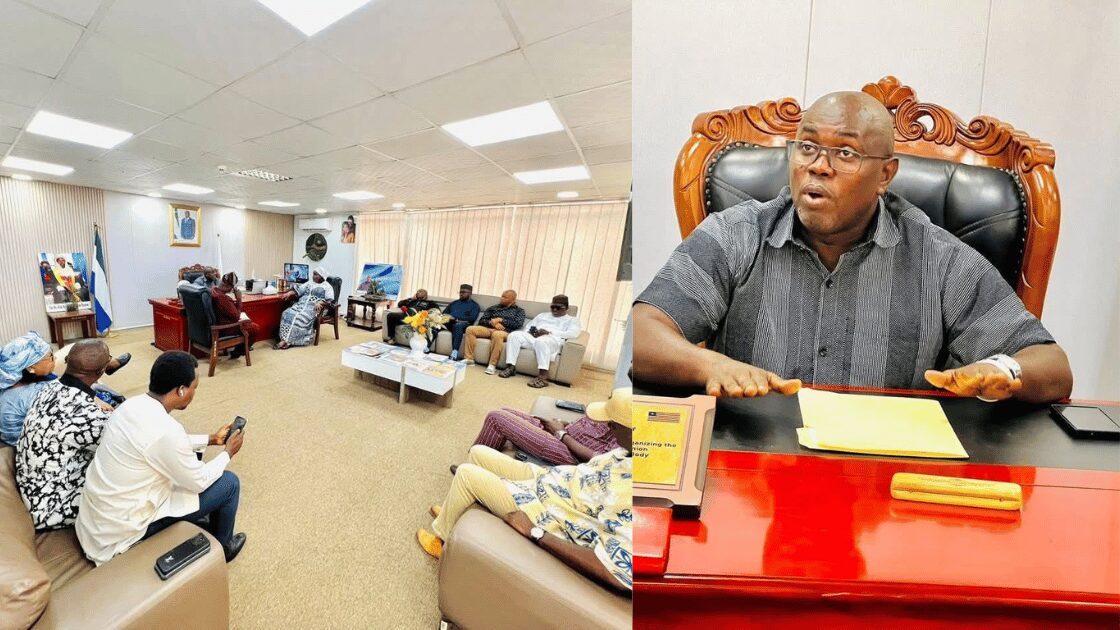
By the time Speaker of Parliament Rt. Hon. Segepoh Solomon Thomas called opposition Members of Parliament together for a second time on Friday, 10 April 2026, the weight of the moment was unmistakable. Weeks had passed since his first attempt at mediation. The seats on the opposition benches remained empty. And the business of the nation bills that needed debating, legislation that needed scrutiny continued to pile up, unattended.
Thomas met again with All Peoples Congress (APC) lawmakers in what is fast becoming one of the more delicate diplomatic exercises in Sierra Leone’s recent parliamentary history: an effort by the legislature’s presiding officer to persuade members of its own body to simply show up.
At the heart of the meeting, Thomas offered an explanation and an apology of sorts. He had promised, at their previous engagement, to relay the concerns of the opposition directly to President Julius Maada Bio and bring back a response. That feedback, he acknowledged, had not materialised not because of any lack of will on his part, but because the President had other pressing engagements that prevented the meeting from taking place. It was a candid admission that underscored the complexity of his position: a Speaker trying to serve as bridge between two political camps whose relationship has deteriorated sharply over recent months.
His core message to APC legislators, however, was unambiguous. He pleaded with them to resume their constitutional duties. Parliament, he reminded them, was not an extension of the executive branch. It was an independent institution one that belonged as much to the opposition as to the ruling party. To abandon it because of executive actions, he argued, was to cede ground that the opposition itself had a right and a responsibility to hold.
The APC’s withdrawal from parliamentary proceedings did not emerge in a vacuum. The boycott was triggered by the party’s objection to President Bio’s appointment of Edmond Sylvester Alpha as Chairman of the Electoral Commission for Sierra Leone (ECSL) a decision the opposition says is politically motivated and threatens the integrity of elections ahead of 2028.
The grievance runs deeper than one appointment. The APC has framed the boycott as a direct response to what it describes as the government’s failure to implement key recommendations from a tripartite national peace accord, including electoral reforms that were agreed upon with the involvement of ECOWAS, the African Union, and the Commonwealth. Their demand is clear: before they return to the chambers, those commitments must be honoured.
On 25 March 2026, Speaker Thomas held high-level talks with opposition leaders in a first attempt to break the deadlock, urging them to return to Parliament and emphasising the institution’s constitutional independence. The APC, however, maintained its position. Friday’s meeting was his second attempt a signal of both his persistence and the depth of the impasse.
The consequences of the boycott are not merely symbolic. With APC lawmakers absent, Parliament has continued to transact business under a largely SLPP-dominated chamber. That arrangement raises serious questions about the quality of legislative scrutiny being applied to government actions and about whether laws passed in the absence of a functioning opposition can truly claim democratic legitimacy.
Civil society has grown increasingly vocal. The Executive Director of Accountability Now Sierra Leone, William Sao Lamin, has strongly condemned the ongoing boycott, warning that it is having serious consequences for ordinary citizens particularly in local councils where service delivery has reportedly slowed or stalled. His message to all parties was direct: the needs of the people must come before partisan considerations.
Former APC Cabinet Minister Alpha Kanu, now serving as Presidential Spokesman in the SLPP-led government, has also weighed in, calling the boycott a serious political miscalculation. He argued that by staying away from Parliament, APC lawmakers are denying their own constituents the opportunity to be represented in national deliberations, and warned that mechanisms exist within the law to appoint alternative representatives if MPs remain absent for an extended period.
If the boycott itself was politically charged, the government’s response has done little to cool tensions. The APC has rejected a government directive introducing what it describes as an “interim political head” to oversee APC-led local councils — a move the party says lacks legal and statutory backing and amounts to an unconstitutional usurpation of elected authority.
The situation came to a head in Tonkolili District, where a letter from the council’s Chief Administrator confirmed that four SLPP councillors were convened in Freetown and instructed to nominate an “interim political leader” to act in place of the elected council head with the nominee subsequently granted access to the government’s financial management system. Opposition figures have described this as a dangerous precedent, one that strikes at the very heart of Sierra Leone’s post-war decentralisation framework.
An ECOWAS delegation is now expected in Freetown to address the broader political impasse a development that suggests the international community is watching events unfold with some concern, and that resolution may ultimately require more than the goodwill of a single presiding officer.
Speaker Thomas finds himself in a genuinely difficult position. His role is, by its nature, meant to be above the partisan fray — a guardian of parliamentary procedure and an honest broker between competing political forces. But when those forces are as deeply entrenched as they are today, the neutrality of the office can only go so far.
His decision to hold a second meeting with APC MPs and to be transparent about his failure to deliver on his earlier promise to bring a presidential response reflects a seriousness of purpose that deserves acknowledgment. He is, by all accounts, trying. The question is whether his efforts will be enough to move two sides that have both dug deeply into their respective positions.
His warning to APC lawmakers carries genuine weight: critical bills are awaiting parliamentary consideration. The business of governance does not pause for political standoffs. Every week that the opposition benches sit empty is a week in which legislation affecting millions of Sierra Leoneans passes through Parliament without the scrutiny that a functioning democracy requires.
This is not the first time Sierra Leone has found itself navigating an opposition boycott. In 2023, the APC ended a previous boycott of governance institutions following an agreement brokered with the involvement of the Commonwealth, the African Union, and ECOWAS under terms that saw APC members return to their parliamentary seats in exchange for concessions from the government. That experience offers both a template and a warning: the impasse can be resolved, but it requires genuine political will on both sides.
What is different this time is the context of a heightening political atmosphere. Prominent figures have warned of inflammatory rhetoric emerging from senior actors within the ruling party, with opposition leader Abdul Kargbo describing the situation as a dangerous pattern that threatens democratic stability. Against that backdrop, the Speaker’s measured and persistent diplomacy stands as one of the few forces actively working to keep dialogue alive.
Read Also: Sylvia Blyden says APC MPs cannot be replaced from other party lists
For now, the APC has made no public indication that it intends to return to Parliament. The Speaker’s second meeting may not have produced a breakthrough but it has kept a door open that, in Sierra Leone’s current political climate, could very easily have swung shut.
Whether that door remains open long enough for both sides to walk through it remains the central question facing the country’s democracy.