
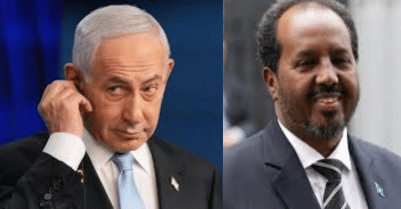
In the strongest and clearest terms possible, the President of Somalia, Hassan Sheikh Mohamud, has responded to a decision that has sent shockwaves through the Horn of Africa by labeling Israeli Prime Minister Benjamin Netanyahu’s recent recognition of Somaliland as an independent state illegal, a threat to regional stability, and a violation of international law.
On 26 December 2025, Israel became the first country in the world to officially recognize Somaliland – a self-declared republic in northwestern Somalia that has functioned with a large degree of autonomy since its declaration of independence in 1991 but was never officially recognized by the international community.
President Mohamud, addressing a special joint session of Somalia’s federal parliament, described the recognition as “the greatest violation” of Somali sovereignty in recent history, accusing Netanyahu’s government of disregarding established diplomatic norms and international law. He affirmed that Somalia and its people remain united and indivisible despite external interference.
Wakaaladda Wararka Qaranka Soomaaliyeed
“My government firmly rejects any declaration by a foreign power purporting to recognise Somaliland as a sovereign state,” Mohamud said. “Such actions are null and void and represent an attack on the territorial integrity and independence of the Federal Republic of Somalia.”
Somalia’s parliament formally adopted a resolution declaring Israel’s move null and void under Somali and international law and directed the government to communicate the country’s position to key international bodies, including the United Nations, African Union, and the Intergovernmental Authority on Development (IGAD).
International reaction has been swift and largely critical of Israel’s decision. Several African and Arab states, as well as major regional organizations, have condemned the recognition on the grounds that it undermines Somali sovereignty and could destabilise the Horn of Africa a region already grappling with security challenges.
The African Union reiterated its commitment to respecting existing colonial-era borders, a principle meant to prevent fragmentation across the continent, and reaffirmed support for Somalia’s territorial integrity.
Similarly, nations such as Turkey, Egypt, and others in the Organisation of Islamic Cooperation have denounced the move as a violation of international norms that risks setting a dangerous precedent for separatist movements elsewhere.
Somalia’s foreign ministry has described the recognition as “state aggression that will never be tolerated”, with demands for Israel to reverse the decision.
Leaders in Hargeisa, the capital of Somaliland, have welcomed Israel’s recognition as a long-awaited breakthrough after more than three decades of diplomatic isolation. Lobbying for international acceptance, Somaliland’s leadership said the step could pave the way for broader global cooperation and economic partnerships.
Reuters
Israel framed its decision within the context of the Abraham Accords, its diplomatic normalization agreements with several Arab states, and expressed intent to pursue cooperation with Somaliland across areas such as agriculture, health, technology, and economic development.
Somaliland’s assertion of statehood traces back to 1991, when it unilaterally declared independence following decades of civil war and the collapse of Somalia’s central government. Despite maintaining its own government, currency, flag, and relatively stable peace compared to southern Somalia, it has remained unrecognised globally — until now.
For Somalia, however, Somaliland’s independence is seen as an existential threat to the unity of the nation and a breach of its constitutional territorial integrity. President Mohamud warned that foreign recognition of secessionist regions undermines national sovereignty and could encourage other movements that destabilise established states.
Legal experts note that unilateral recognition of breakaway regions without widespread global backing can strain diplomatic relations and unsettle regional balances. African nations, in particular, have emphasised the need to maintain colonial-era borders to preserve peace, as set out in the African Union’s foundational principles.
Somalia’s government and parliament are expected to pursue diplomatic avenues at the United Nations and other international fora to counteract what they describe as “illegal interference” and to seek broader support for their position.
As the situation continues to evolve, the tense situation in the Horn of Africa can be expected to persist. President Mohamud has made it clear that his country will protect the territorial integrity of Somalia while engaging in negotiations with Somaliland within the rules of international laws.
Read Also: Guinea Goes to the Polls as Junta Leader Mamady Doumbouya Dominates First Post-Coup Election
The establishment of recognition between Somaliland and Israel affects not only the future of the bilateral relationship, but it also has implications for the overarching questions surrounding sovereignty, the right of self-determination, and the rules of statehood in the contemporary international system.