
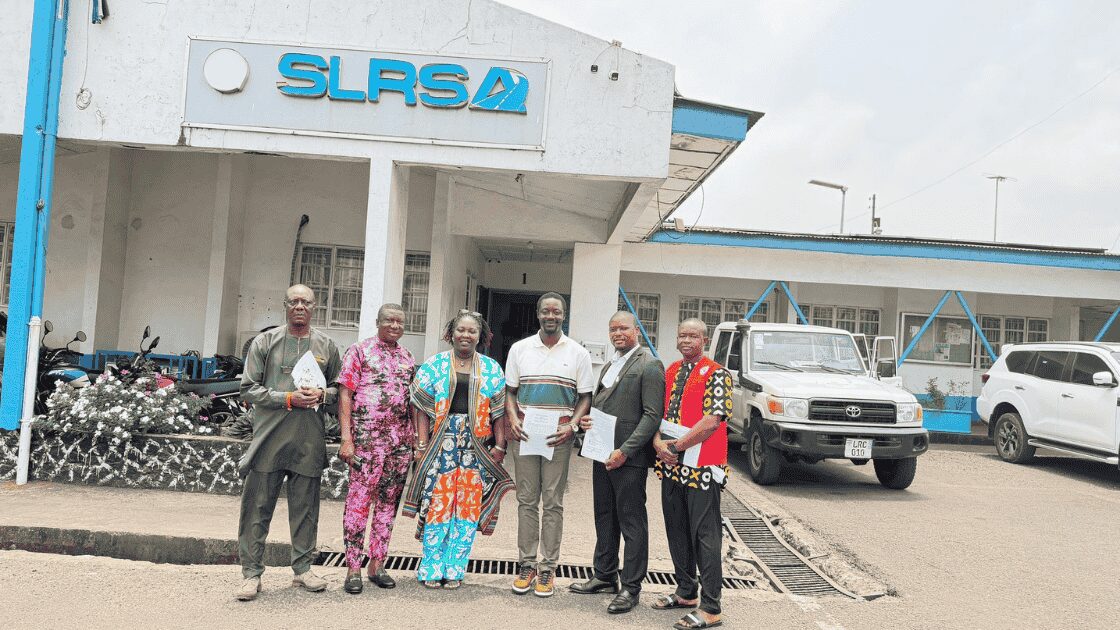
Every day on Sierra Leone’s roads, the gap between a traffic crash and meaningful medical assistance can mean the difference between life and death. It is a gap that has persisted for years shaped by under-resourced emergency services, poor road conditions, and a public health infrastructure still rebuilding from decades of strain. On a recent morning at the Sierra Leone Road Safety Authority’s headquarters on Kissy Road in Freetown, officials from two of the country’s most consequential public institutions sat down to begin closing it.
The Sierra Leone Road Safety Authority (SLRSA) and the Sierra Leone Red Cross Society (SLRCS) have officially signed a Memorandum of Understanding, establishing a formal framework for collaboration in road safety education, first aid training, accident response, and emergency coordination. The signing marks what both institutions describe as a pivotal moment in their shared mission to save lives on Sierra Leonean roads.
The backdrop against which this agreement was signed is sobering. According to World Health Organisation data, road traffic accident deaths in Sierra Leone reached 2,581, representing 4.26% of total deaths with an age-adjusted death rate of 41.61 per 100,000 population, ranking the country 21st in the world for road traffic fatalities.
Sierra Leone ranked 21st out of 185 countries globally in 2020 for road traffic accident-related deaths, and the burden of road traffic accidents in Sub-Saharan Africa has increased by over 80% in the past three decades. Research conducted at Connaught Teaching Hospital in Freetown between 2020 and 2022 found that head injuries and lower limb injuries were among the key factors associated with death from road traffic accidents injuries for which rapid, skilled first-aid intervention is often the critical variable.
According to the Sierra Leone Roads Transport Authority, an estimated 1,035 fatalities occur on the country’s roads annually a figure that public health researchers and road safety advocates say almost certainly understates the true toll, given persistent challenges in data collection and crash reporting across the country.
The MOU is designed to address precisely this reality. By formalising cooperation between the authority mandated to regulate road safety and the organisation with the deepest humanitarian infrastructure in the country, the agreement creates a structure for more coordinated, faster, and better-resourced responses when crashes occur.
Speaking at the ceremony, SLRSA Executive Director James Bagie Bio underscored that the agreement was not a symbolic gesture but a functional one, tied directly to the Authority’s core mandate. He emphasised that closer collaboration with the Red Cross would enhance the provision of timely medical assistance to crash victims a recognition that road safety does not end with enforcement and education, but extends into the critical minutes and hours after an accident occurs. Public education, he noted, would also receive a significant boost through the partnership, with sustained sensitisation campaigns forming a key pillar of the collaboration.
For his part, SLRCS Secretary General and CEO Kpawuru E.T. Sandy anchored his remarks in history. The Red Cross Society has been delivering humanitarian and emergency health services in Sierra Leone since its establishment in 1962 over six decades of presence at the intersection of need and response, from the civil war to the Ebola crisis and beyond. Sandy reaffirmed the organisation’s enduring commitment to vulnerable communities and expressed genuine enthusiasm for the implementation of the MOU, framing the partnership as a natural extension of the Red Cross’s humanitarian purpose.
The SLRSA-SLRCS partnership arrives at a moment when road safety has moved firmly onto the regional and global agenda. The United Nations General Assembly adopted a resolution in September 2021 proclaiming the Second Decade of Action for Road Safety 2021–2030, with the ambitious target of preventing at least 50% of road traffic deaths and injuries by that date. Africa’s traffic fatality rate of 19.5 deaths per 100,000 people makes the continent the most affected region in the world.
Sierra Leone itself has attracted high-level attention on the issue. Jean Todt, the United Nations Secretary-General’s Special Envoy for Road Safety, visited Sierra Leone and encouraged President Bio to collaborate with other African leaders to prioritise road safety at the African Union level, citing the continent’s second 10-year plan under Agenda 2063 as a vehicle for achieving the goal of halving road traffic deaths by 2030.
In 2013, the government of Sierra Leone launched a national road safety policy and strategic plan to curb the number of road traffic accidents and their fatalities. The MOU between SLRSA and SLRCS represents the latest and potentially one of the most operationally significant additions to that long-term framework.
At its core, the agreement establishes structured collaboration across three interconnected areas. First aid training will be expanded and institutionalised, ensuring that more Sierra Leoneans and more emergency responders in particular are equipped to render effective assistance at crash scenes before ambulance services arrive. Accident response coordination between the two institutions will be formalised, reducing the confusion and delays that currently cost lives. And road safety sensitisation will be jointly conducted, combining the SLRSA’s regulatory authority with the Red Cross’s extraordinary community reach across all fourteen districts of the country.
Both institutions have reaffirmed their commitment to fully implementing the provisions of the agreement a statement that will be watched closely by road safety advocates, civil society, and the families of the thousands of Sierra Leoneans touched each year by the tragedy of preventable road deaths.
Read Also: Seven African Referees Named for 2026 FIFA World Cup as Ndala, Issa Sy and Laryea Miss Out
The signing of this MOU will not, by itself, transform Sierra Leone’s road safety landscape. The country faces deeply structural challenges poor infrastructure, inadequate enforcement, an expanding fleet of motorcycles and commercial vehicles outpacing regulatory capacity, and a healthcare system under constant pressure. But what it does represent is a recognition, formalised in ink and witnessed by both institutions, that the response to road crashes requires the same kind of coordinated, sustained, multi-agency effort that Sierra Leone has mobilised against other public health crises.
In a country where thousands of lives are lost or shattered on the roads every year, coordination is not a bureaucratic nicety. It is a life-saving imperative. Today, at least, that imperative has a framework.