
Fédération Internationale de Football Association (FIFA) most expansive officiating lineup in World Cup history includes seven officials from the continent but the notable absences have stirred debate across African football
Football’s biggest stage will have an African presence in the middle of the pitch when the 2026 FIFA World Cup kicks off this northern summer. FIFA has unveiled its final list of match officials for the tournament, comprising 52 referees, 88 assistant referees, and 30 video match officials drawn from all six confederations and 50 Member Associations described by the governing body as the most extensive officiating lineup in World Cup history.
Seven African referees have made the final cut for the 2026 FIFA World Cup, which will be hosted across the United States, Canada, and Mexico, with the expanded 48-team tournament running from June 11 to July 19, 2026.
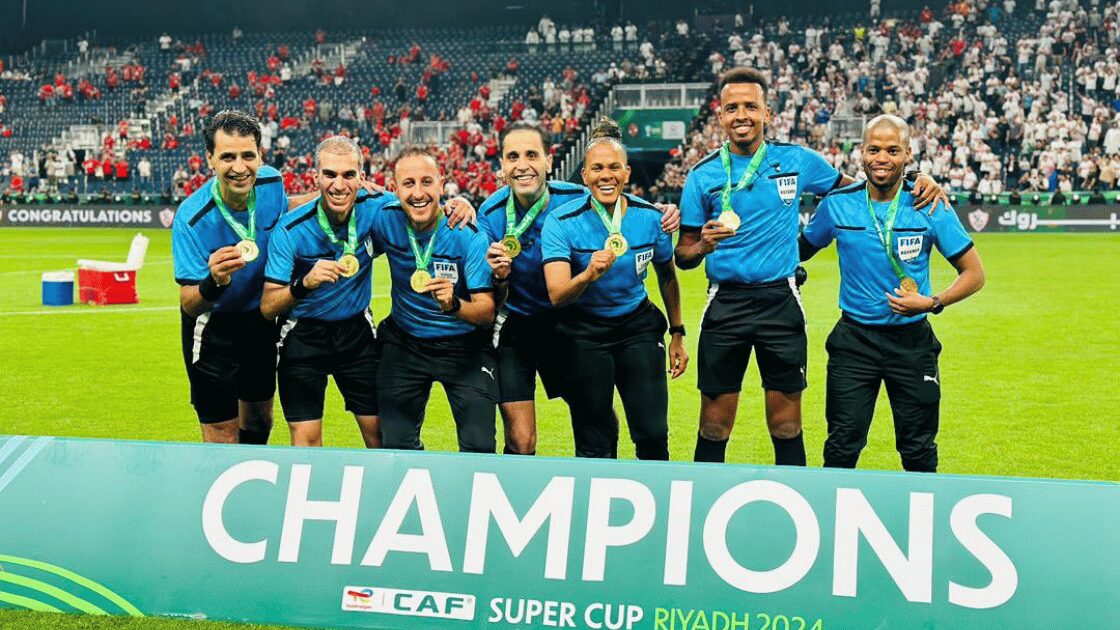
The selected referees are Mustapha Ghorbal (Algeria), Amin Mohamed (Egypt), Pierre Atcho (Gabon), Jalal Jayed (Morocco), Dahane Beida (Mauritania), Tom Abongile (South Africa), and Omar Artan (Somalia).
Mustapha Ghorbal of Algeria is widely respected for his calm authority and has built a reputation for handling high-pressure matches across Africa. Amin Mohamed of Egypt is a seasoned referee with extensive experience in club competitions, known for his composure and technical accuracy. Pierre Atcho of Gabon has steadily gained prominence in both domestic and continental fixtures, recognised for consistency and fairness. Jalal Jayed of Morocco is well accustomed to officiating intense, high-stakes encounters. Dahane Beida of Mauritania is an emerging name noted for his strict but balanced officiating style. Tom Abongile of South Africa is a familiar face in CAF competitions, regarded as one of the continent’s reliable referees.
Perhaps the most historically significant inclusion is that of Omar Artan. For Somalia, his selection marks a historic milestone Artan has already made headlines as the first Somali referee to officiate at a FIFA tournament, notably at the U-20 World Cup, underlining his rapid rise in international refereeing.
The scale of this World Cup demands an officiating corps to match. According to Pierluigi Collina, chairman of the FIFA Referees Committee, the selected officials emerged from a rigorous process spanning more than three years. “The selected match officials are the very best in the world,” Collina stated. “They were identified, monitored, and assessed consistently in domestic and international competitions, as well as at FIFA tournaments.” He noted that FIFA’s appointed team for 2026 includes 41 more officials than were appointed for Qatar 2022.
Technology will again play a central role, with goal-line technology, an enhanced semi-automated offside system, and connected ball technology all set to be deployed. For the first time, fans will also gain access to the referee’s on-field perspective through body cameras enhanced by artificial intelligence. All selected officials will converge in Miami on 31 May for a 10-day preparatory seminar ahead of the tournament.
The celebration of Africa’s seven selections has been tempered by the controversy surrounding who did not make the list. Notably absent are Jean-Jacques Ndala of DR Congo and Issa Sy of Senegal, both of whom have previously officiated high-profile matches.
The omission of Ndala is widely seen as a consequence of the chaotic 2025 AFCON final in Morocco, where Senegal players walked off the pitch in protest at his decisions, halting the game for several minutes in one of African football’s most dramatic and charged atmospheres. Though CAF did not formally sanction Ndala following that final, FIFA has taken the decision to exclude him from the 2026 World Cup.
Issa Sy’s exclusion follows controversy during a CAF Champions League clash between Al Ahly and Espérance Sportive de Tunis, in which he was alleged to have used a red card to threaten players a serious charge that FIFA appears to have weighed heavily in its deliberations. Ghanaian referee Daniel Laryea was also left out of the final selection, further fueling debate within African football circles.
Read Also: World Trade Organisation and FIFA unveil ARISE IIP’s innovative products.
Despite the controversy surrounding the omissions, the selection of seven African referees for one of the most expanded World Cups in history is a signal worth acknowledging. Their inclusion reflects both individual excellence and the growing recognition of African officiating on the global stage. From Algeria’s experienced Ghorbal to Somalia’s trailblazing Artan, the continent’s officials will carry more than personal ambition onto those pitches they will carry the weight of a football-mad continent’s expectations.