
Peace Signed in Conakry: Guinea, Sierra Leone and Liberia Step Back From the Brink in Historic MRU Summit
After weeks of soldiers crossing borders, flags being torn down, and gunfire wounding civilians, the three leaders of the Mano River Union chose dialogue and the region exhaled
In a moment of profound diplomatic relief for a region that had been holding its breath, the Presidents of Guinea, Sierra Leone, and Liberia gathered in Conakry on Monday, March 16th, 2026, and signed a landmark joint communiqué pledging peace, dialogue, and the peaceful resolution of all border disputes bringing to a close, at least for now, the most dangerous chapter in Mano River Union relations in over two decades.
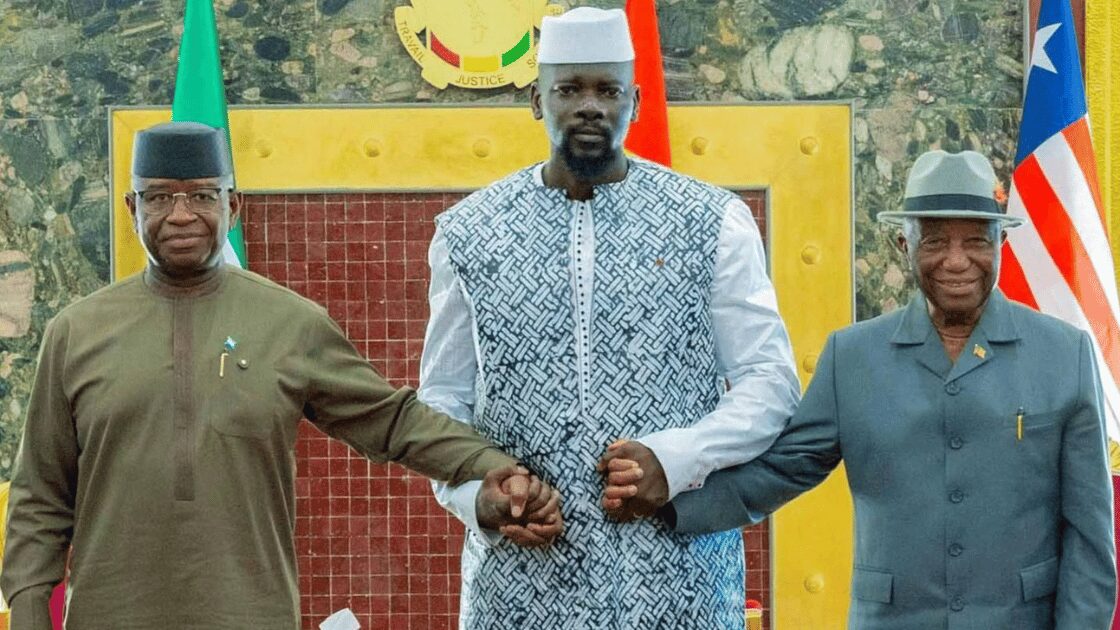
The summit brought together President Mamadi Doumbouya of Guinea, President Joseph Nyuma Boakai of Liberia, and President Julius Maada Bio of Sierra Leone, with Côte d’Ivoire participating as an observer. The summit focused on strengthening cooperation to address recent tensions in border communities and to promote stability within the Mano River Union (MRU).
The meeting, held in a cordial and frank atmosphere under the framework of the Mano River Union (MRU), ended Monday evening with the adoption of a joint communiqué emphasising dialogue over the use of force in addressing border-related concerns. Bloomberg
The three heads of state returned to their respective capitals Bio to Freetown, Boakai to Monrovia leaving behind in Conakry something the region has desperately needed: a signed commitment, a roadmap for peace, and a fragile but real hope.
The joint communiqué, broadcast live on Guinean state television and confirmed by the official websites of both the Sierra Leone Presidency and the Liberian government, contains several landmark provisions.
In the final communiqué, the leaders reaffirmed their unwavering commitment to the principles of sovereignty, territorial integrity, political independence and good neighbourliness, and agreed that all border-related disputes would be resolved through dialogue and diplomatic mechanisms.
They “reaffirmed their commitment to preserve peace and stability in the Mano River region and avoid any escalation of tensions at the borders.” The leaders also announced the creation of joint technical commissions to examine issues related to border delimitation and management signalling a move toward institutional mechanisms for addressing longstanding territorial disagreements.
Critically, the three leaders agreed to maintain the status quo ante regarding current border positions while negotiations continue toward an amicable, acceptable, and lasting solution an approach intended to preserve the longstanding trade, commerce, and cultural ties among border communities.
The leaders further agreed to strengthen joint surveillance and conflict-prevention mechanisms along their borders, and announced plans to convene a full Mano River Union summit within one month to revitalise the organisation and enhance regular dialogue on peace, security, and development among member states.
The Presidents also signalled their intention to undertake reciprocal working visits to further cement the fraternity among their nations a gesture of personal goodwill that underscored the spirit in which the communiqué was signed.
Perhaps the most significant early test of the communiqué’s sincerity came not in words but in action and it came swiftly.
In a decisive implementation of the summit’s resolutions, Guinea’s military issued Communiqué No. 003, signed by General Ibrahima Sory Bangoura, Chief of the General Staff of the Guinean Armed Forces, confirming a “progressive easing of the defence apparatus” along the country’s borders with Sierra Leone and Liberia. The move took effect on Tuesday, 17 March 2026 just hours after the summit concluded and is widely seen as a confidence-building measure aimed at restoring calm along the frontiers.
The speed of the drawdown was remarkable given that just 24 hours earlier, President Doumbouya had personally dispatched armoured vehicles, artillery, and a helicopter to the very same border, declaring before assembled troops that “not a single portion of the land left by our ancestors will be taken.” While announcing the troop drawdown, the Guinean military commended its defence and security forces for their “proactiveness and self-control” during the period of heightened tensions, while simultaneously reaffirming its unwavering commitment to defending national sovereignty highlighting the delicate balance Guinea is trying to strike between peace and military preparedness.
At the centre of the breakthrough was President Julius Maada Bio, who, in his dual capacity as President of Sierra Leone and Chairman of the Authority of Heads of State and Government of the Economic Community of West African States (ECOWAS), delivered a strong message of unity and peace.
President Bio said the purpose of the gathering was to reaffirm the commitment of MRU member states to peace, dialogue, and mutual respect for sovereignty while strengthening mechanisms for cooperation among neighbouring countries. He expressed confidence that open discussions among the region’s leaders would lead to practical solutions that would maintain peace along the borders and reinforce the spirit of regional unity that the Mano River Union (MRU) represents.
It was a role that required Bio to simultaneously be a grievance-holder Sierra Leone’s soldiers had been arrested and held by Guinean forces just three weeks earlier and a peacemaker acting in the wider interest of a region he chairs. That he managed both in the same room speaks to the gravity of the moment all three leaders understood they were navigating.
Recognising that peace is the foundation of national growth and development, the three leaders demonstrated strong leadership and reaffirmed their commitment to maintaining solid bilateral relationships as neighbouring countries, emphasising their collective responsibility to preserve stability and cooperation within the region.
For Liberia’s President Boakai, the Conakry summit represented the culmination of one of the most difficult weeks of his presidency. His country had watched Guinean soldiers cross its border, tear down its flag, confiscate construction equipment, deploy helicopters, and fire a weapon that hospitalised a Liberian citizen. The domestic pressure to respond with force had been intense.
Within Liberia, the unfolding situation had generated strong reactions from political figures, analysts, and citizens calling for national unity. Montserrado County District Three Representative Sumo Mulbah urged Liberians to avoid politicising the issue and instead rally together in defence of the country’s sovereignty and territorial integrity, cautioning that public displays of division could weaken Liberia’s diplomatic position at a time when unity was required.
Boakai chose restraint throughout. He sent delegations, not soldiers. He called for talks, not retaliation. And in Conakry, he brought a strong message of peace and stability, emphasising the importance of protecting border communities and ensuring that disputes are resolved without further harm to civilians.
The outcome a communiqué that preserves the status quo while committing to a negotiated settlement is a vindication of that patience.
The communiqué is a beginning, not an end. Behind the warm photographs and signed documents lie two deeply contested territorial disputes that have defied resolution for decades.
On the Sierra Leone–Guinea border, the diamond-rich Yenga region remains the central flashpoint. Despite a 2005 memorandum of understanding and a 2012 demilitarisation agreement both recognising Yenga as Sierra Leonean territory, the area has remained a source of tension. The arrest of 16 Sierra Leonean soldiers in late February and their subsequent release resolved the immediate crisis but not its root cause.
On the Liberia–Guinea border, the Sorlumba crossing and the Makona River remain disputed. The joint technical commissions announced in the communiqué will be tasked with the painstaking work of border delimitation a process that, across West Africa, has historically taken years rather than weeks.
The current tensions are rooted in long-standing disagreements over colonial-era boundaries and control of mineral-rich areas. The Mano River Union (MRU), established in 1973 to facilitate free trade and economic cooperation, has a troubled history of cross-border conflict.
The Mano River Basin has a painful history that must never be forgotten. The civil wars that once engulfed Liberia and Sierra Leone and destabilised Guinea’s border regions demonstrated how fragile peace can become when mistrust, political ambition, and military posturing are allowed to dominate relations among neighbours. Those conflicts cost hundreds of thousands of lives, displaced millions, destroyed infrastructure, and delayed development across the region for decades.
The outcome of the Conakry consultations is expected to ease tensions, restore confidence among affected communities, and facilitate the resumption and growth of cross-border economic activities.
But for the residents of Foya District in Lofa County who watched foreign soldiers raise another country’s flag on their soil, for the schoolchildren who were hurriedly sent home in fear, for Edward T. Lebbie the Liberian official shot and wounded by gunfire and for the Sierra Leonean soldiers who spent five days in Guinean detention, paper promises will only go so far.
The test of Conakry’s communiqué will not be in the elegant diplomatic language of its final text. It will be in whether Guinean soldiers stay on their side of the Makona River. It will be in whether the joint technical commissions actually convene and produce actionable border demarcation. It will be in whether the full MRU summit promised within one month actually happens and whether, when it does, it produces the deeper institutional reform this region needs.
Read Also: Mano River Union (MRU) Leaders To Meet In Conakry to Address Border Crisis In The Region
At this moment, the message to the leaders of Liberia, Guinea, and Sierra Leone must be clear: safeguard the peace that the region has struggled so hard to achieve. Choose diplomacy over provocation, cooperation over confrontation, and unity over division. The stability of the Mano River Basin and the future of millions who call it home depends on that choice.
For now, the guns are quiet. The flags are where they should be. And three presidents who, weeks ago, were staring at the possibility of armed conflict have chosen, in Conakry, to look at each other as brothers instead.
That is not nothing. In the Mano River Basin, it is everything.