

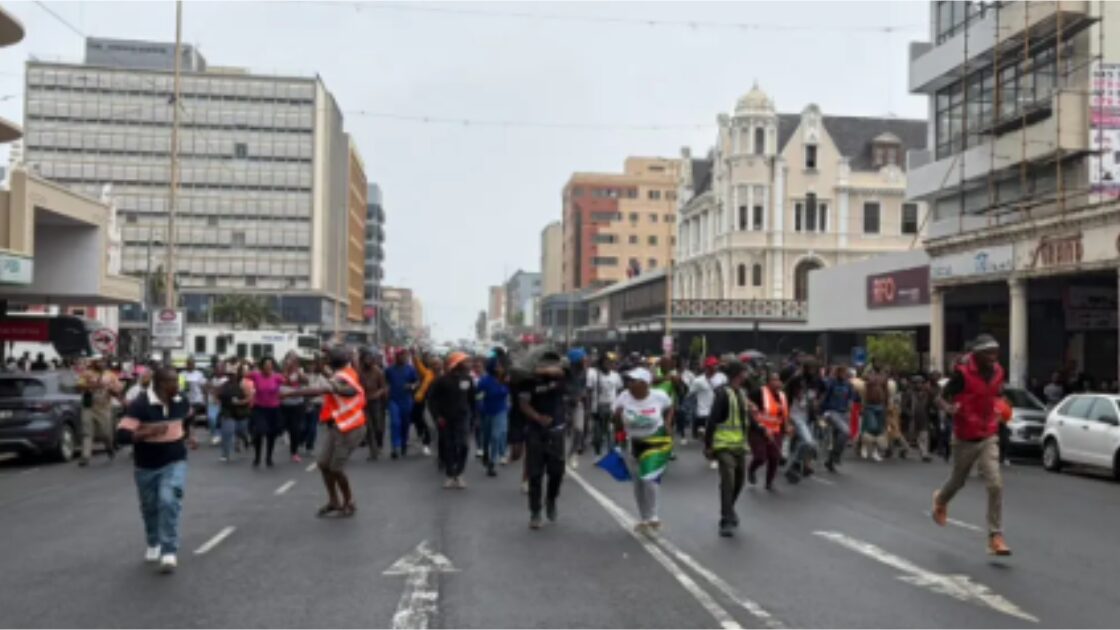
The streets of KuGompo City are filled this morning with protesters traditional leaders in ceremonial dress, ActionSA members in party colours, civic organisation representatives, and ordinary residents united by a single demand: investigate, prosecute, and deport the Nigerians behind what they are calling an illegal, humiliating, and sovereignty-violating coronation of a foreign king on South African soil.
Scores of KuGompo City residents and traditional leaders on March 30, 2026 are protesting the coronation of a “Nigerian king” in the city. Members of political parties, including ActionSA, have also joined in to protest the coronation of Igbo chief Solomon Ogbonna Eziko as king.
The events leading to this moment began over the weekend when videos began circulating on social media showing celebrations in the kuGompo area of what appeared to be a coronation ceremony. The videos showed celebrations linked to the coronation of a Nigerian national, Chief Solomon Ogbonna Eziko, under the title “Igwe Ndigbo Na East London.” Within hours, those videos had been viewed millions of times and had ignited one of the most explosive public controversies South Africa has seen in months.
The controversy followed reports that a Nigerian national, Solomon Ogbonna Eziko, was installed as “Igwe Ndigbo” a title representing the leader of the Igbo community during a ceremony held over the weekend in the kuGompo area.
The title “Igwe” is a traditional Igbo designation for a community leader or king a culturally significant role within Igbo communities both in Nigeria and in the diaspora. Igbo communities across the world regularly install community leaders to serve as cultural custodians, mediators, and symbols of communal identity. In Ghana, in the United Kingdom, in the United States Igbo diaspora communities have appointed their own “Ezes” and “Igwes” for decades without triggering diplomatic crises.
But in KuGompo City, Eastern Cape a province with some of the most deeply rooted and constitutionally protected traditional leadership structures in all of Africa the ceremony landed very differently. The disputed location falls within the jurisdiction of King Jonguxolo Vululwandle Sandile of the amaRharhabe Kingdom, a factor that has further heightened the sensitivity of the situation.
The Eastern Cape House of Traditional and Khoi-San Leaders condemned the alleged coronation, describing it as a “flagrant violation of established customary protocols” and a direct challenge to recognised authority. The House stressed that South Africa’s traditional leadership system is governed by legislation, including the Traditional and Khoi-San Leadership Act, which does not permit the establishment of parallel kingship structures without due legal process.
The language used by South Africa’s traditional establishment to describe the ceremony has been striking in its intensity. No institution chose its words more forcefully than the Royal House of AbaThembu.
AbaThembu senior royal advisor Matthew Mpahlwa described the ceremony in the starkest possible terms: “It’s a simple act of terror. The Eastern Cape is not an annexure or a colony of Nigeria. There is no purpose for anyone to start spreading misinformation that we welcome and will give a Nigerian national royalty in the Eastern Cape who has no connection to the land that he occupies. So, it’s a simple act of terror, and we treat it as such, and we are saying the government must act on it. In fact, later today we will be making a call to the Consul General of Nigeria to come and explain this.”
Significantly, the AbaThembu Royal House simultaneously distanced itself from viral social media posts purporting to show AbaThembu King Buyelekhaya Zwelibanzi Dalindyebo welcoming the Nigerian king. “It would appear that the social media posts are a product of fake news, sick and depraved minds,” the Royal House said confirming that the images circulating online misrepresented the King’s position and that no such recognition had ever been granted.
Chairperson of the Eastern Cape House of Traditional and Khoisan Leaders, Nkosi Mpumalanga Gwadiso, condemned the reported coronation as unacceptable and unlawful. He noted that the area where the incident reportedly occurred falls under the authority of the amaRharhabe kingdom, led by King Sandile. Gwadiso warned that the action amounted to “a flagrant violation of established customary protocols and a direct affront to traditional leadership institutions and the country’s constitutional and legislative framework.” He added: “The house is particularly concerned that this reckless conduct carries the potential to inflame tensions and jeopardise social cohesion. Traditional leaders in this province and beyond have consistently stood against xenophobia, violence and division. However, actions of this nature are irresponsible and may provoke avoidable conflict if left unaddressed.”
Government institutions moved quickly to distance themselves from the ceremony and signal that the full weight of the law would be brought to bear.
Eastern Cape cooperative governance and traditional affairs MEC Zolile Williams said he had learnt “with shock” of the development which allegedly took place in the amaRharhabe kingdom and rejected it outright. “Any nefarious attempt to defy and undermine the sovereignty of our country will be met with the full might of the rule of law.”
The Department of Cooperative Governance and Traditional Affairs (COGTA) took a firm stance, describing the ceremony as an “unlawful impersonation and purported coronation of an individual falsely presenting himself as a traditional leader.” Deputy Minister of COGTA, Reverend Prince Zolile Burns-Ncamashe, slammed the installation, saying such conduct is inconsistent with South African law and democratic principles.
The controversy has united South Africa’s political spectrum across party lines from the centre to the far left in a display of rare cross-partisan solidarity.
ActionSA said in a statement: “South Africa is a sovereign country, and ActionSA will not stand by while a group of foreigners arrogates itself authority to install and coronate a king on South African soil.” The party made specific reference to the amaRhadebe Kingdom under King Vululwandle Sandile, calling the ceremony a “blatant disregard for recognised traditional leadership.” ActionSA leader Athol Trollip personally committed to joining Monday’s march.
The Pan Africanist Congress of Azania (PAC) described the reported coronation as unlawful and a direct challenge to South Africa’s established traditional leadership systems, noting that the ceremony took place on land under the authority of King Jonguxolo Vululwandle Sandile of the AmaRharhabe Kingdom.
The African Transformation Movement (ATM) expressed strong rejection and deep concern over the alleged coronation, stating: “The installation of any king or chief is not a ceremonial act that can be conducted arbitrarily or imported from foreign tradition.”
CONTRALESA President Kgosi Mathupa Mokoena was equally uncompromising: “No person can be a king without traditional leaders under them. If they have kingship in their family, let them be recognised in their own country, not here in SA. This group is undermining our Constitution and the laws of our country. Government must stop this nonsense and take this group to task.”
Standing at the eye of this storm, the Nigerian Igbo community in South Africa has offered a very different account of what happened and what it means.
The apex Igbo socio-cultural organisation, Ohaneze Ndigbo South Africa (ONSA), denied that any formal coronation took place, insisting the gathering was a cultural community event rather than a formal installation of a traditional ruler claiming territorial authority.
Despite the backlash, Eze Chukwudi Ihenetu and other Igbo leaders maintained that the title was purely ceremonial, intended to unify the Igbo diaspora and promote cultural identity, without any political or territorial ambitions.
The Igbo community’s position that this was a diaspora cultural gathering, not a territorial claim mirrors the argument made by Igbo communities elsewhere. The incident mirrors a similar controversy reported in July 2025 in Ghana, where the installation of Eze Chukwudi Ihenetu as “Eze Ndi Igbo Ghana” triggered protests and public outrage over concerns about sovereignty and the preservation of indigenous chieftaincy systems.
In both cases, the Igbo community insisted on cultural intent. In both cases, the host country’s population heard something else entirely.
Beneath the cultural and legal arguments lies an allegation that, if substantiated, would transform this story from a misunderstanding into a scandal.
ISANCO is calling for a full investigation into the event, including allegations of “brown envelopes” bribery being used to facilitate the ceremony. “We are closely engaging with the traditional leadership to get to the root of this despicable occurrence,” ISANCO President Dr. Zukile Luyenge said.
The implication is deeply serious: that someone within the traditional leadership structure of the Eastern Cape accepted payment to permit, facilitate, or lend credibility to a ceremony that every official institution has since condemned as illegal. If true, it means the outrage is not merely about a misguided cultural event it is about corruption at the heart of one of South Africa’s most sacred institutions.
That investigation has not yet yielded findings. But the allegation alone has deepened public anger and given protesters additional cause to demand accountability beyond simply deporting those involved in the ceremony itself.
No honest account of this story can ignore the broader context in which it is unfolding. South Africa has a tragic and well-documented history of xenophobic violence particularly directed at other African nationals, and most frequently at Nigerians and Zimbabweans. Waves of violence in 2008, 2015, and 2019 killed dozens, displaced thousands, and sent shockwaves through the African Union.
Traditional leaders have consistently stood against xenophobia, violence and division and that consistency matters. The line between legitimate outrage over a legally dubious ceremony and a generalised campaign against Nigerian nationals in South Africa is a thin one, and it is a line that agitators on both sides of the debate are capable of exploiting.
The protest organisers have framed their demands around legality investigate the ceremony, apply immigration law, deport those found to be undocumented. But in a country where “deport the Nigerians” has historically been a precursor to violence rather than a legal process, those demands carry a weight that transcends their stated intentions.
South Africa’s IFP party Minister of Home Affairs Velenkosini Hlabisa struck the most measured note of any official, describing what was shown on social media as “just the Sunday school playing of kids who do not know what they are actually doing, except playing” a deliberate attempt to deflate the controversy before it escalates beyond the point of management.
For Nigeria already locked in a tense diplomatic relationship with South Africa, already watching its citizens deported, attacked, and subjected to xenophobic rhetoric the Igbo King controversy arrives at a deeply uncomfortable moment.
The Nigerian consul general in KuGompo has been summoned. The diplomatic machinery is turning. And somewhere in the calculus of Abuja’s foreign ministry, officials are asking whether the cultural autonomy of the Igbo diaspora a matter of deep pride within Nigeria is worth the diplomatic cost it is now generating in South Africa.
For the Igbo community in KuGompo City, the answer may feel obvious: it was a community celebration. It was never a territorial claim. They are not trying to annex the Eastern Cape.
Read Also: South African court rules that men can take wife’s surname
But sovereignty, like dignity, is not always about intent. It is about perception. And in a country that has endured colonialism, apartheid, and decades of foreign powers drawing lines on its map, the sight of a foreign national being crowned “king” on South African soil however ceremonially touches something ancient and non-negotiable.
The streets of KuGompo City are full today. The protesters are loud, organised, and angry. Whether their anger produces justice, policy, or violence will depend on the leaders traditional, political, and civic who are marching at the front of that crowd.