
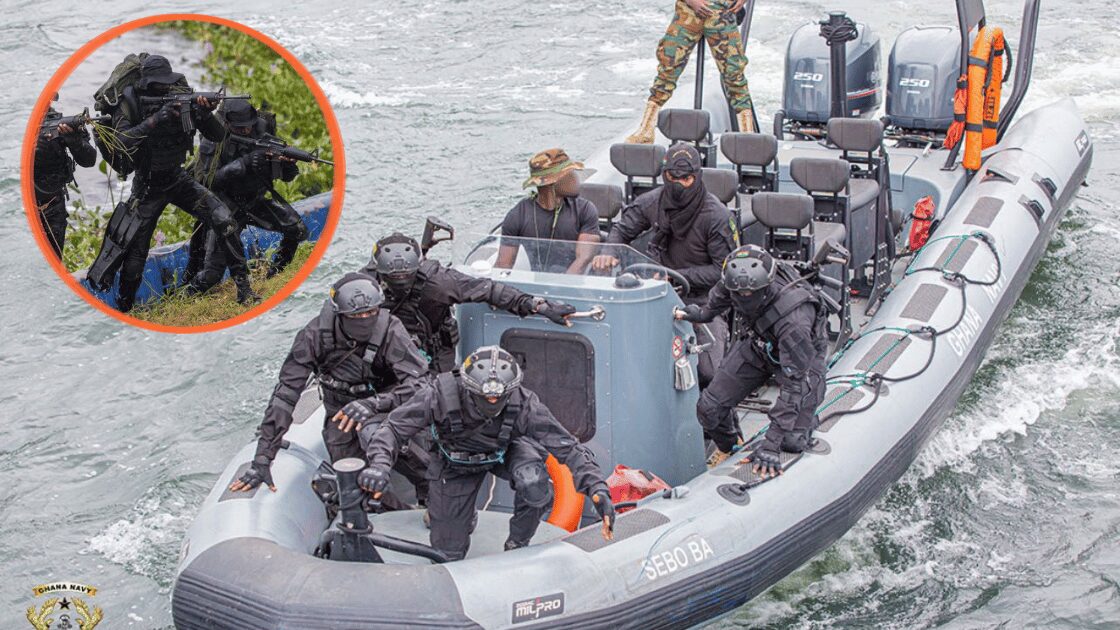
They were almost ashore. The canoe had made it through open water, past Ghana’s coastline, and was approaching the beach at Goi a quiet coastal settlement south of Sege near Ada when the operatives of the Ghana Navy’s Special Boat Squadron emerged from the darkness. What happened next took seconds. The suspects abandoned their vessel and fled into the night. They left behind everything.
The Ghana Navy successfully intercepted a canoe transporting 37 sacks of suspected Indian hemp during a maritime operation conducted at Goi, south of Sege. The operation, which took place on Friday, March 27, 2026, was executed following credible intelligence that enabled operatives of the Special Boat Squadron to track and apprehend the suspect vessel as it attempted to land along the coastal area. The suspects abandoned the canoe and fled upon encountering the operatives, resulting in no immediate arrests.
A thorough search of the vessel revealed 37 sacks of compressed substances believed to be Indian hemp. A preliminary assessment conducted by the Narcotics Control Commission suggests that each sack contained approximately 70 parcels. Additional items confiscated from the canoe included an outboard motor, two gallons of premix fuel, and five empty gallons.
The arithmetic is staggering: 37 sacks, approximately 70 parcels each a total of approximately 2,590 parcels of suspected cannabis in a single wooden canoe on a Friday night on Ghana’s southern coast. This was not a petty smuggler with a few kilograms tucked under fishing nets. This was a structured, well-resourced, and apparently well-practised maritime trafficking operation one that knew the coastline, had fuel for a return journey, and simply did not account for the possibility of naval intelligence good enough to find them in the dark.
The seized canoe and all exhibits have since been transported to the Tema Fishing Harbour and handed over to NACOC for forensic analysis and further investigations.
The Goi Beach seizure was not a lucky encounter. It was the product of exactly the kind of intelligence-led maritime operation that Ghana’s naval establishment has been investing in and it unfolded precisely as designed, with one significant exception: the suspects escaped.
The operation was carried out by operatives of the Special Boat Squadron acting on intelligence. According to a press release issued by the Department of Public Relations at General Headquarters, Burma Camp, the operatives tracked and pursued the canoe as it attempted to land. The suspects abandoned the vessel and fled when they saw the operatives.
The SBS Ghana’s elite maritime special operations unit has been at the forefront of the country’s increasingly assertive coastal interdiction posture. In December 2024, Ghana commissioned its largest forward operating base at Ezinlibo, on the Gulf of Guinea, near the border with Côte d’Ivoire, with more bases planned for the coastal towns of Ada, Elmina, Keta and Winneba. Goi Beach, where Friday’s operation unfolded, sits within the Ada coastal corridor precisely the zone the navy has been working to bring under tighter surveillance.
Preliminary evaluative findings conducted in collaboration with the Narcotics Control Commission reveal that each individual sack harboured approximately seventy distinct parcels, thereby indicating a highly organised packaging and distribution framework suggestive of transnational trafficking networks. Further scrutiny of the vessel uncovered supplementary logistical implements, including a mechanically functional outboard propulsion engine, dual containers filled with premixed marine fuel, as well as five additional empty receptacles all of which collectively point toward a well-resourced and strategically planned smuggling expedition designed for sustained mobility across coastal waters.
The empty gallons are a particularly revealing detail. Traffickers operating in this coastal corridor typically carry excess fuel to enable rapid transit across open water and a return journey if the landing is aborted. Five empty gallons alongside two full ones suggests the canoe had already consumed significant fuel meaning it had travelled a considerable distance before attempting to land at Goi. The origin point of that journey remains part of the active investigation.
The Goi Beach seizure is the latest chapter in a trafficking story that has been building along Ghana’s Atlantic coastline for years and accelerating with alarming speed.
West Africa’s Atlantic coastline has become a key corridor for narcotics trafficked from Latin America to Europe. Its geographic position, porous borders, and limited maritime surveillance capacity have made the region attractive to transnational trafficking networks. Over the past decade, West African states particularly coastal countries such as Guinea-Bissau, Senegal, Côte d’Ivoire, and Ghana have become major transit points.
For Indian hemp specifically cannabis sativa grown domestically and transported by sea to avoid road checkpoints the coastal canoe route has become a preferred trafficking method precisely because it exploits the gap between Ghana’s land-based enforcement infrastructure and its maritime capacity. Checkpoints on the Accra–Ada road have pushed traffickers seaward. The canoe, the outboard motor, and the pre-dawn landing are not improvised choices. They are calculated adaptations to enforcement pressure.
The 2025 GI-TOC mapping update reveals an alarming southward drift of criminal economies from the Sahel into the coastal West African states Ghana, Benin, Togo, and Côte d’Ivoire. Originally insulated from Sahelian instability, these countries now face an encroaching web of arms trafficking, gold smuggling, fuel diversion, and drug flows, reinforced by corrupt patronage networks. The region’s ports and transport corridors once symbols of integration have become dual-use gateways for licit and illicit trade.
Ghana’s own recent enforcement record illustrates the scale of what is being intercepted and what is almost certainly not. Since 2025, security agencies have intercepted multiple shipments of illegal substances, exposing major trafficking networks operating through Ghana. Among the most notable incidents was a large cocaine seizure in March 2025, when authorities confiscated about 3.3 tonnes of cocaine with an estimated street value of around $350 million described as one of the largest drug busts in Ghana’s history. Around the same period, a second truck was stopped on the Takoradi–Cape Coast highway with an estimated 120 slabs of cocaine valued at around $150 million.
Friday’s Indian hemp seizure is a different drug and a different trafficking model but it is embedded in the same coastal criminal ecosystem.
The most significant operational gap in Friday’s seizure and the one that will define what investigators can actually achieve from it is the complete absence of arrests.
The suspects saw the SBS operatives and ran. In a coastal environment of darkness, shallow water, and dense surrounding terrain, the navy’s tactical options for pursuit were limited. The canoe was secured. The cargo was seized. The crew was gone.
This outcome common in maritime drug interdictions worldwide means the investigation now depends almost entirely on forensic and intelligence analysis of the seized items rather than testimony from those who operated the vessel. The outboard motor’s serial number, the canoe’s construction characteristics, the specific packaging of the 2,590 parcels, the type and origin of the premix fuel all of these are potential leads for NACOC’s forensic team at Tema Fishing Harbour.
Traffickers are exploiting intelligence gaps. Multi-tonne consignments are brought in on fishing vessels and motorboats and are trans-shipped at sea before being brought on land. But this does not add up to the quantities being brought into the region intelligence gaps regarding drug flows are making coastal routes a safer option for traffickers, with a lower risk of disruption.
The fact that the suspects were confident enough to operate this close to Accra in a corridor the navy has been actively monitoring, on a route that runs directly into Ada, less than 100 kilometres from the capital suggests either extraordinary boldness or a degree of prior success on this route that had bred complacency. Either way, NACOC’s forensic work will be critical to determining whether this canoe was a one-off or one of many.
Friday’s operation reflects a Ghana Navy that is investing seriously in the intelligence and operational infrastructure needed to interdict maritime drug trafficking even if the execution does not always produce arrests alongside seizures.
Ghana’s increasing collaboration with the European Union, Germany, and France has positioned Accra as a new stabilising force in the region. In September 2025, the Tonnerre, a French amphibious warship, entered the port in Tema to participate in Siren, a regional joint navy training exercise focused on anti-piracy, pollution control and crisis-response drills.
Rear Admiral Godwin Livingston Bessing, Ghana’s chief of naval staff, confirmed the country’s more assertive maritime posture: “We are in the process of acquiring offshore patrol vessels to enhance our operational capabilities. This ensures we are better prepared to secure our maritime territory and counter both traditional and emerging threats.”
The intelligence that drove Friday’s operation to Goi Beach in the first place is itself evidence that the investment is producing results. An SBS unit does not arrive at a precise coastal landing point at the precise moment a drug canoe is attempting to come ashore without either sustained surveillance or a reliable human intelligence source. The navy knew where to be and when to be there.
INTERPOL’s Project WATA has been working to promote intelligence efforts and international cooperation to combat maritime crimes, improving the crime scene management capabilities of first responders including navies, and strengthening security of port infrastructure across Ghana, Benin, Côte d’Ivoire, Nigeria, and Togo. Ghana’s SBS operatives are the human embodiment of that investment trained, positioned, and increasingly capable of acting on the intelligence they receive.
Ghana’s Goi Beach seizure does not exist in a regional vacuum. Across West Africa’s coastline, from Dakar to Lagos, the maritime drug trafficking corridor is under increasing pressure from better-coordinated enforcement and traffickers are adapting accordingly.
At least 30% of cocaine trafficked to Western Europe is being routed through West Africa, and several of the world’s most powerful organised crime groups now operate in West Africa’s cocaine market. Drug trafficking has also provided terrorists with the means to operate in areas where they would not otherwise have such a strong presence in the West African region, evidence points to the use of drug trafficking networks by terrorists to transport arms and other illicit goods, as well as to smuggle people across borders.
A 2025 INTERPOL Operation Screen across 12 West African countries including Ghana, Liberia, Nigeria, Sierra Leone, and Senegal netted 45 arrests, seized weapons and counterfeit documents, and identified multiple international fugitives, demonstrating both the scale of the regional enforcement effort and the depth of the criminal networks it is targeting.
Indian hemp, while less glamorous than cocaine in terms of headline value, is the drug that most directly feeds street-level addiction across Ghana and its neighbours and the maritime canoe route is its primary supply chain along the coast. Every seizure disrupts that chain, increases the cost and risk for traffickers, and if followed through with prosecution sends a message that the sea is no longer open territory.
NACOC’s forensic team at Tema Fishing Harbour now holds the key to how much value Ghana extracts from Friday’s seizure beyond the physical removal of 2,590 parcels from the trafficking chain.
The immediate priorities are clear: confirm through laboratory analysis that the substance is indeed cannabis sativa. Trace the outboard motor and canoe to their registered owners if possible. Analyse the packaging for fingerprints, DNA, or distinctive characteristics that might link this consignment to previous seizures or known networks. Cross-reference intelligence from the tip that produced Friday’s operation with broader signals from the region.
And then most critically pursue the suspects who ran. Coastal communities near Goi are small. Canoe operators are known in their local waters. The Ghana Navy, NACOC, and the Ghana Police Service have a window of opportunity to identify and arrest those who operated Friday’s vessel before the trail goes cold and the network simply retasks another crew and another canoe.
The cargo is at Tema. The network is still out there. The real work has just begun.