
Today, February 1st, marks the beginning of the Artisanal Fishing Closed Season announced by the Ministry of Fisheries and Marine Resources. On paper, it is a conservation measure. On the ground in Tombo, it feels like a sudden pause on life itself.
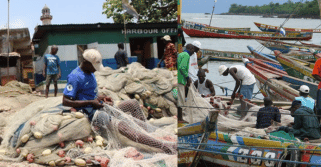
At Tombo Wharf, the usual rhythm is gone. The early-morning rush, the shouting across boats, the sound of engines coughing awake, all of it has faded. Boats are packed tightly along the shore, resting not by choice but by order. Fishermen walk slowly, some with hands in their pockets, others standing in small groups with nothing to do and nowhere to go. People pass aimlessly, as if waiting for an instruction that never comes.
The Ministry explains that the closed season, from February 1st to March 1st, is meant to allow fish stocks to reproduce during their peak spawning period. Artisanal fishermen are required to stop all fishing activities for one month. Boats must remain at the landing wharfs. Fishermen are encouraged to repair their nets and boats. The government assures the public that surveillance will be carried out by fisheries officers, the navy, marine police, and CMAs to deter defaulters.
For Tombo, these explanations offer little comfort.
Fishing here is not seasonal work. It is not a side trade. It is the only economy the town knows. When fishing stops, income stops. Food stops. School fees stop. Medical care stops. There is no government stipend, no emergency food support, no clear plan to cushion families whose survival depends entirely on daily catch.
Many fishermen say they feel punished rather than protected.
Abu Kamara, an ordinary fisherman at the wharf, speaks with quiet frustration.
“We have been fishing this sea since I was young,” he says. “This is the first government that has stopped us from going to the sea for a whole month.”
For him, and many others, fishing is not just tradition. It is memory, skill, and inheritance. It is what their fathers did, and what they were raised to do.
Another fisherman, Saidu, does not hide his worry.
“I have my sick old mother, my wife, and my children to take care of,” he says. “My only work is fishing. I don’t know anything else. Now I am thinking about how I will feed them, and I don’t even know where to start.”
Some fishermen have already made painful choices. A few are preparing to leave Tombo temporarily, crossing into neighboring Guinea and Liberia to continue fishing. Others cannot afford transport or lack contacts across the border. They will remain behind, waiting out the month with empty nets and heavy thoughts.
What hurts many in Tombo is not the idea of conservation itself. Fishermen understand the sea better than anyone. They know what overfishing looks like. They have seen catches shrink over the years. But they also know that the greatest damage has not come from their wooden boats and small nets. It has come from industrial trawlers, often foreign, that scrape the seabed and destroy breeding grounds far beyond the reach of artisanal fishing.
Yet enforcement rarely begins there.
Instead, it begins in towns like Tombo, where the people have the least power, the least savings, and the fewest alternatives. Conservation, when applied without fairness or support, becomes a burden placed on those already struggling.
As the sun sets over Tombo Wharf, the boats remain still. The sea is calm, but the town is restless. Behind every packed canoe is a family calculating how to survive the next thirty days.
Read Also: Budapest-Bamako Rally Returns to Sierra Leone in 2026 as HATTIS Calls for Massive Welcome
For the fishermen of Tombo, this closed season is not just about fish stocks.
It is about hunger, dignity, and the unanswered question of how a community built entirely around the sea is expected to live when the sea is taken away.