

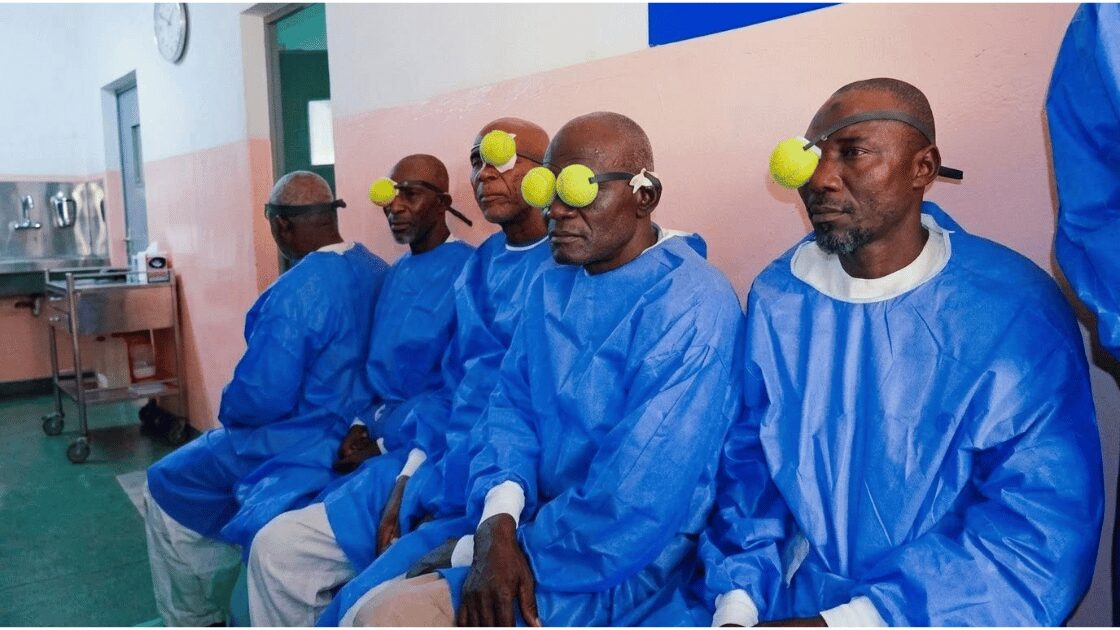
In a continent where millions wake up every day unable to see not because medicine cannot help them but because medicine cannot reach them, a medical convoy from Egypt arrived in Chad’s capital, N’Djamena, carrying something that costs very little to give and means everything to receive: the gift of sight.
Egypt’s medical team made the journey to perform 500 free cataract surgeries on Chadians living with a condition that, in most of the world’s wealthier nations, is resolved in a matter of minutes under local anaesthetic and forgotten by morning. In much of sub-Saharan Africa, including Chad one of the world’s poorest and most medically underserved countries it remains one of the leading causes of permanent blindness, simply because the surgery is unavailable, unaffordable, or too far away to reach.
This convoy is a medical mission. But it is also, in its quiet way, a political statement about what intra-African solidarity can mean in practice, and about the scale of the crisis it is responding to.
To understand why this convoy matters, you must first understand the scale of what blindness does to a community.
Across the African continent, approximately 26.3 million people live with some form of visual impairment. Of these, 5.9 million are estimated to be blind outright representing 15.3% of the world’s entire blind population, concentrated on a continent that holds roughly 17% of the world’s people.
Globally, cataract is the single largest cause of distance vision impairment and blindness, affecting an estimated 94 million people. Crucially, one in two people globally who need cataract surgery cannot access it. In Africa, that access gap is even more acute. Research shows that cataracts account for 46% of all cases of blindness across sub-Saharan Africa the leading cause, ahead of glaucoma and every other condition.
What makes this especially painful is that cataract blindness is, in the overwhelming majority of cases, entirely curable. A single surgical procedure, costing as little as a few dozen dollars when performed in volume, can restore full vision. The darkness is not inevitable. It is a consequence of poverty, geography, and the chronic underfunding of healthcare systems that were never designed to serve the millions who need them.
Across sub-Saharan Africa, cataract prevalence among older adults ranges from 13.5% to 62.5% depending on country and context. Surgery is the primary management strategy, but cataract surgical coverage varies wildly from as low as 12.1% to 96% depending on location. Significant barriers include lack of awareness, limited access to healthcare, economic constraints, gender disparities, and cultural misconceptions.
Chad sits among the most vulnerable countries in this picture. Landlocked, chronically under-resourced, and hosting one of the world’s largest refugee populations due to the ongoing Sudan crisis, the country’s health system operates under relentless and compounding strain. Ophthalmological care specialist, equipment-heavy, and requiring trained surgeons is among the first things that falls through the cracks.
Against this backdrop, Egypt’s decision to dispatch a medical team to N’Djamena to perform 500 free cataract surgeries is a meaningful act, both practically and symbolically.
Practically, 500 surgeries means 500 people who may have spent months or years navigating daily life in progressive darkness unable to work, unable to care for children or grandchildren, unable to see the faces of the people they love who will leave a surgical chair and walk into a world that has colour and clarity again. In communities where a single breadwinner going blind can push an entire household into deeper poverty, the ripple effects of restored sight extend far beyond the individual.
Symbolically, the convoy represents something that the African continent has long spoken about but struggled to operationalise: south-south solidarity in healthcare. Egypt, with its established medical infrastructure and a long tradition of ophthalmological training and research, is sharing that capacity with a neighbour across the Sahara not through a Western-funded programme, not as part of a foreign aid package from Europe or North America, but as a direct act of bilateral African cooperation.
It is the kind of initiative that the Mano River Union, the African Union, and countless pan-African frameworks have called for in their founding documents for decades. Egypt doing it quietly, practically, without fanfare is worth noting.
Egypt is not alone in pursuing this kind of medical outreach. The Sahel and Lake Chad basin have attracted several such interventions in recent years, from various partners. In 2023, Pakistani ophthalmologists, operating through the Organisation of Islamic Cooperation’s COMSTECH in collaboration with the Islamic Development Bank and Pakistan’s Layton Rehmatullah Benevolent Trust, completed 400 cataract surgeries in Chad over eight days at a local hospital in N’Djamena, with support from Chad’s Ministry of Health. That mission also focused on training local doctors in the latest surgical techniques recognising that external convoys, however welcome, are not a substitute for building permanent local capacity.
More recently, the Alliance to Fight Avoidable Blindness, funded by the Tzu Chi Foundation and implemented in partnership with the Islamic Development Bank, donated cataract surgery equipment to Chad and several other African countries. By November 2025, the equipment provided to Chad had already enabled more than 2,000 surgeries.
These are all welcome developments. But they also reveal the weight of the challenge. Hundreds of surgeries here, two thousand there — each one genuinely transformative for the individual patient, but still a fraction of the tens of thousands who remain in darkness across Chad and its neighbours.
Sub-Saharan Africa’s age-standardised prevalence of blindness is the highest of any region in the world, nearly double the world average. Despite some improvement since 2000, the region did not meet the Vision 2020 targets set by international health bodies and because of population growth and ageing, the total number of people with visual impairment has actually increased even as the rate has improved.
What Egypt’s convoy to Chad and missions like it ultimately points toward is a structural question that no single convoy can answer: why does Africa, a continent of over 1.4 billion people, still lack the ophthalmological infrastructure to treat one of its most common and most curable causes of disability?
The World Health Organisation estimates that the annual global cost of productivity lost to vision impairment stands at US$411 billion. The burden falls disproportionately on the poorest countries and communities those least able to absorb it.
The solution is not more convoys, though convoys help. The solution is investment in training local surgeons, equipping local hospitals, subsidising surgeries for those who cannot pay, and building the kind of sustained, government-funded eye care infrastructure that citizens of wealthy nations take entirely for granted. A cataract surgery that takes fifteen minutes to perform should not require a foreign medical team to travel hundreds of kilometres to make possible.
Until that infrastructure exists, however, the convoys matter enormously to the men and women sitting in those surgical chairs in N’Djamena, waiting for light.
It is easy, when dealing with a crisis as large as blindness across the African continent, to become numbed by numbers. Five million blind. Ninety-four million globally with cataracts. Hundreds of millions without access to surgery.
Read Also: Egypt is set to increase its minimum wage to $147 in July 2026.
But in N’Djamena, in the days and weeks of this Egyptian medical mission, the arithmetic becomes human. A grandmother who will see her grandchildren’s faces. A farmer who will go back to his field. A child whose parent will be able to walk her to school again. A man who sat in the dark for years and who, on the other side of a fifteen-minute procedure, will blink and see the sky.
Five hundred people. Five hundred stories. In each one of them, an entire world restored.
Egypt did not have to come to Chad. The fact that it did — that African nations are beginning, in whatever measure, to tend to one another is a reason for hope in a region that has often had to look elsewhere for it.