

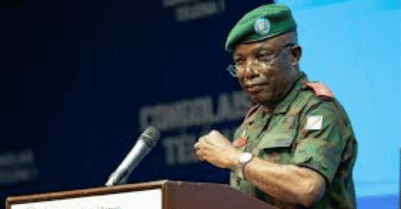
The Democratic Republic of Congo has moved swiftly to suspend its military spokesperson after comments that reopened old wounds in a country still struggling to heal from decades of conflict.Major General Sylvain Ekenge, the public face of the Congolese army, was taken off his duties after appearing on state television and warning Congolese men against marrying Tutsi women.
The remarks sparked immediate outrage across the country and beyond, drawing criticism from civil society groups, political leaders, and human rights advocates who described the comments as dangerous, divisive, and deeply irresponsible.
In a statement, the Congolese army confirmed Ekenge’s suspension, stressing that his words did not reflect the values or position of the armed forces. The military leadership emphasized that hate speech has no place in a national institution tasked with protecting all citizens, regardless of ethnicity or background.
The army reaffirmed its commitment to unity, discipline, and equal protection under the law.In eastern Congo, words can inflame tensions as quickly as bullets.Ethnic identity, especially involving the Tutsi community, sits at the heart of one of Africa’s longest and most complex conflicts. Any public statement that singles out a group carries heavy historical weight.
The Tutsi population in eastern Congo has long been caught in the middle of regional rivalries, armed rebellions, and cross-border tensions, particularly between Kinshasa and Kigali. Against this backdrop, Ekenge’s remarks were widely seen as pouring fuel on an already smoldering fire.
Observers warned that such statements risk legitimizing discrimination at a time when restraint and responsibility are urgently needed from state officials.
The roots of the conflict in eastern DR Congo stretch back to the aftermath of the 1994 Rwandan genocide, when armed groups and refugees flooded into Congolese territory. What followed were two devastating wars between 1996 and 2003, often referred to as “Africa’s World War,” involving multiple African countries and countless militias.
Although a formal peace was declared, violence never fully ended. Armed groups, including the M23 rebels, various Mai-Mai factions, and foreign-linked militias, have continued to operate in the east, exploiting weak state authority and competition over land, minerals, and political influence.
Ethnic narratives have repeatedly been weaponized during these conflicts, deepening mistrust and justifying cycles of revenge.
Today, eastern Congo remains unstable. Fighting between government forces and the M23 rebellion has displaced hundreds of thousands of civilians, while relations with Rwanda are tense, with Kinshasa accusing Kigali of backing rebel forces. Rwanda denies the allegations, but regional diplomacy remains fragile.
In this climate, the Congolese army has tried to present itself as a unifying national force. The suspension of its spokesperson appears to be an attempt to reinforce that message and prevent further damage to public trust.
By acting against Major General Ekenge, the military leadership signaled that public officials will be held accountable for speech that undermines national cohesion. Analysts say the decision was necessary, not only to calm ethnic tensions, but also to reassure communities that the state does not endorse prejudice.
Read Also: Sierra Leone Steps Up War on Drugs as Security Agencies Destroy Over $1 Million Worth of Illegal Substances
For a country still living with the consequences of war, reconciliation remains a slow and delicate process. The episode serves as a reminder that in the Congo, leadership is measured not only by battlefield victories, but by the care taken with words that can either bind a nation together or tear it further apart.