
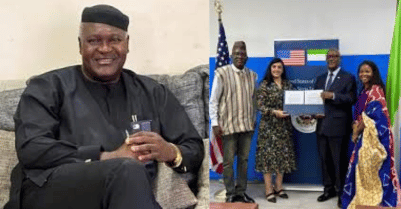
A political tempest is brewing over the recently signed health agreement between the government of the Republic of Sierra Leone and the government of the United States, with Joseph Fitzgerald Kamara, commonly known as JFK, raising serious concerns over the lack of transparency surrounding the agreement.
On 22 December 2025, it was confirmed that the government of Sierra Leone has signed a Memorandum of Understanding with the United States government on 22 December 2025. The government pledged over 129 million dollars. While the announcement was framed as a major boost to public health delivery, JFK, a senior figure in the main opposition All People’s Congress (APC), has publicly warned that the agreement carries serious risks if left unscrutinized.
Posting on his official X (formerly Twitter) account, Kamara described the agreement as presenting “a dual reality,” noting that while the funding could offer significant benefits, it also exposes the country to legal, financial, and sovereignty risks if safeguards are not clearly defined.
“This agreement must not be signed in darkness,” he cautioned, insisting that the government publish the full details of the MOU for public review.
JFK is not a casual commentator. A seasoned lawyer, former Attorney General and Minister of Justice, and once Sierra Leone’s Anti-Corruption Commissioner, Kamara has built a reputation as a legal hardliner with deep knowledge of international agreements and state accountability. Within APC circles, he is regarded as one of the party’s most articulate defenders of constitutionalism and due process.
His intervention has therefore amplified concerns among civil society actors and policy watchers who argue that large-scale international agreements, particularly those involving health systems and foreign funding, often come with conditions that outlive political administrations.
According to Kamara, the central issue is not opposition to international cooperation, but the absence of clarity. He questioned whether the agreement binds Sierra Leone to future obligations, external oversight mechanisms, or policy concessions that Parliament and the public are yet to see.
So far, there have been only general press releases from the government that celebrate the size of the funding and its potential impact. The crucial specificities remain undefined: on the distribution of the funds, the agencies to handle them, the legal jurisdiction in case of disputes, and whether this agreement places long-term liabilities on the state.
Critics feel that without disclosure, Sierra Leoneans cannot ascertain whether the deal strengthens the health sector or quietly mortgages parts of it. It also raises concerns about precedent, particularly in a country with a history of opaque contracts that later triggered debt burdens or legal battles.
JFK’s warning taps into this historical anxiety. By calling for transparency before implementation, he is effectively challenging the SLPP-led government to prove that the deal is about public interest rather than political optics. The controversy also occurs against a charged political background. As trust in public institutions gets strained and given that elections are always at the doorstep, opposition figures increasingly set governance debates around accountability and openness.
Read Also: Sierra Leone’s Apreel and Drizilik Break Through on the Global Stage with Rolling Stone Feature
For the supporters of APC, Kamara’s stance reinforces a long-standing claim that the ruling party prefers closed-door decision-making. Still, for the government, the criticism risks casting a humanitarian partnership in a suspicious light, potentially complicating diplomatic messaging. The crux of the JFK warning was a simple demand: publish the agreement. Allow Parliament, the legal community, health professionals, and ordinary citizens to examine its contents. If the deal is sound, he argues, it should withstand public scrutiny.
Until that happens, the $129 million health pact remains not just a promise of improved care, but a political fault line—one that raises uncomfortable questions about transparency, sovereignty, and who truly benefits when big money meets fragile systems.