
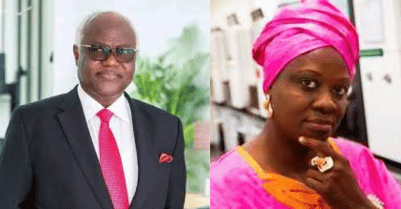
Dr. Sylvia Olayinka Blyden OOR has ignited fresh debate within Sierra Leone’s main opposition party after declaring that the legacy of the All Peoples Congress (APC) is far bigger than former President Ernest Bai Koroma.
In a lengthy and carefully worded post on her Facebook page, the outspoken former minister pushed back hard against what she described as a growing and dangerous narrative within the party: the idea that the APC’s identity, history, and success are inseparable from Ernest Bai Koroma.
According to Blyden, that idea is not just misleading. She calls it an outright falsehood.
She began by making it clear that her intervention was not driven by malice or personal grievance. By sharing a photograph of herself with Ernest Bai Koroma, she said she wanted to underline the mutual nature of their relationship, stressing that she benefited from him just as he benefited from her. But that acknowledgment, she argued, should not be twisted into historical revisionism.
Blyden accused some APC aspirants and power brokers of deliberately shrinking the party’s long and complex history in order to promote current ambitions. In her words, portraying the APC as a creation or extension of Ernest Bai Koroma is “plainly untrue” and amounts to rewriting history for political convenience.
She reminded party supporters that the APC was not born in 2007, nor did it spring into relevance because of one man. Instead, she painted a sweeping picture of a political movement built over decades, across every region of Sierra Leone. From Kailahun to Kent, from the forests of Kamakwie to the diamond fields of Kono, from the rivers that cut through the nation to the streets of central Freetown, Blyden described the APC as a living organism shaped by countless hands, sacrifices, and struggles long before Ernest Bai Koroma emerged on the national stage.
In one of the most striking passages of her post, Blyden warned that those who erase the contributions of the party’s founders and early builders risk losing what she called the “ancestral blessings” that sustained the APC through years of hardship and political battles. To her, history matters not only as record, but as moral grounding.
While acknowledging that Ernest Bai Koroma inherited the APC structure and expanded it during his leadership, Blyden insisted that gratitude must not turn into blind worship. She cautioned that equating APC entirely with Koroma also means inheriting his human weaknesses, including what she pointedly referred to as his post-presidency conduct. In her view, that association does more harm than good to a party seeking renewal and credibility.
“APC equals EBK” is a slogan she urged party members to abandon. Not because Koroma is insignificant, but because no individual, however influential, should eclipse an entire political tradition.
Blyden also drew a line between personal loyalty and institutional memory. She noted that while Koroma may be the sole benefactor to many newer entrants in the party, the APC itself predates those relationships. Before Ernest Bai Koroma, she stressed repeatedly, there was already an APC with roots, structures, and ideals.
Her message was blunt and unapologetic: the APC did not begin with Ernest Bai Koroma, and it will not end with him.
By challenging the party’s internal narrative so publicly, Blyden has reopened long-standing tensions within the APC over leadership, legacy, and direction. Supporters of Koroma may see her words as an attack on a revered figure. Others view it as a necessary correction, and a reminder that political parties outlive individuals.
One thing is clear. Dr. Sylvia Blyden has placed herself firmly on record, daring the APC to confront its own history honestly, without shrinking it to fit the ambitions or image of any single man.