
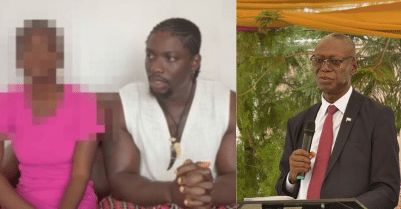
When 18-year-old Isha Francess Dumbuya finally escaped the nightmare that brought her to Nigeria, she believed the hardest part was over. She was wrong.
Isha’s journey began in Freetown, where she sold cake by the roadside to survive. One of her regular customers, a woman she trusted, slowly drew her into a promise that sounded like a way out of poverty. Acting jobs. Nigerian movies. A chance to change her life.
“She used to buy from me,” Isha recalled quietly during an interview with Nigerian activist Martins Vincent Otse, known as VeryDarkman. “She came many times. She told me I would act movies.”
Those movies were the same ones Isha watched back home in Sierra Leone. It felt believable. It felt hopeful.
In April, without telling her parents, Isha left the country. She was not alone. Ten young people traveled from Sierra Leone, alongside others from Mali, Ghana, and Nigeria. They arrived first in Lagos, then moved to Asaba in Delta State. That was where the truth surfaced.
“When we reach Asaba, the woman said it is prostitution,” Isha said.
The teenager refused. She asked to go home. The response was cold and transactional.
“She said I should give her money. I don’t have the money.”
With no support and no way to pay, Isha planned her escape. One night, she ran. On the roadside, she begged a stranger for help. Although he could not take her in due to the fact that he was married, but he decided to help other way. He connected her to a Muslim community in Asaba, where she was given shelter for the night and a chance to explain her situation.
Community members advised her to travel to Abuja and seek help from her country’s embassy. For Isha, that advice carried hope. An embassy, after all, is supposed to be a place of safety. A place where citizens stranded abroad can find protection, temporary shelter, documentation, and help to return home.
Instead, she says she was turned away.
“When I reached the embassy, they said there is no money and no place to keep me,” Isha said.
For an 18-year-old girl, trafficked, homeless, and alone in a foreign country, those words cut deep.
Diplomatic missions are not charities, but they are not indifferent offices either. Embassies exist to protect citizens abroad, especially the most vulnerable. Their responsibilities include offering consular assistance, liaising with local authorities, helping victims of trafficking, facilitating safe repatriation, and ensuring that nationals are not left exposed to further harm.
In Isha’s case, none of that appears to have happened.
Ironically, it was the Ghana Embassy that listened. Security officials there took time to hear her story and asked questions about her condition. It was also a Nigerian activist, not Sierra Leonean officials, who stepped in next. Very Darkman gave Isha a phone and publicly committed to helping her with transportation back to Sierra Leone.
Her story has reopened painful conversations about human trafficking in West Africa, where young girls working informal jobs are routinely targeted with false promises of work, travel, and fame. It has also raised uncomfortable questions about the role of state institutions meant to protect citizens when those promises collapse.
For Isha, survival came through strangers and communities, not official channels. For many Sierra Leoneans watching her interview, the most disturbing part was not the trafficker’s deception, but the moment their own embassy reportedly said it could do nothing.
Read Also: Dr. Sylvia Blyden Throws Public Challenge at Ady Macauley Over Alleged Secret Payments By SLPP
As Isha prepares to return home, her story stands as more than a personal tragedy. It is a test of national conscience. Embassies may struggle with funding and logistics, but telling a trafficked teenager that there is “no money and no place” risks turning vulnerability into abandonment.
And that is a failure no country should ignore.