
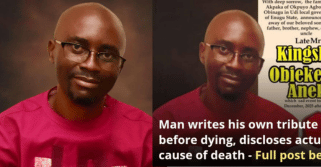
The final words of Kingsley Obiekezie Aneke read like a quiet goodbye and a painful indictment of a system that failed him long before his heart finally gave out. He did not write with anger alone. He wrote with hope bruised by reality, with love for a country he believed could be better, and with the exhaustion of a man who had fought illness and neglect at the same time.
Kingsley had lived for years with a heart condition. It was not a secret struggle. It was a managed one. Regular care, discipline, and the guidance of a trusted cardiologist kept him alive and functional. Like many Nigerians, he believed that consistency and medical follow-up were enough. Then the familiar story intervened. His cardiologist left the country, driven abroad by a broken health system that could not retain its own best hands. From that point, Kingsley’s condition worsened. Not suddenly, but steadily, as gaps replaced certainty.
On 24 November 2025, he was admitted into the hospital that had treated him for years. It was a place where he had often recovered before. This time was different. When his condition became critical, doctors knew he needed a referral to the Lagos University Teaching Hospital for specialist care. That door was closed. LUTH, like many public hospitals across Nigeria, was on strike. The very institutions meant to save lives had been silenced by neglect, unpaid wages, and broken promises.
With no public option left, his family turned to private hospitals. Evercare Lekki and Dukes Neurosurgery and Specialist Hospital were approached. Both demanded deposits running into millions of naira before care could begin. In desperation, Dukes Hospital in Victoria Island was chosen. What followed still echoes in Kingsley’s words. He felt reduced to an invoice. Treatment was delayed. Billing continued. The urgency of his condition competed with the urgency of payment.
Despite his family’s sacrifices, despite their willingness to give everything they had, Kingsley sensed that profit mattered more than his pulse. On 5 December 2025, he lost the battle. He was not defeated by his heart condition alone. He was defeated by strikes, by capital flight, by a health system split between abandonment and extortion.
In his final message, Kingsley did not spare the system that killed him. He spoke directly to those who defend bad governance simply because their tribe holds power. He reminded them that Nigerians die daily from what can be fixed. Bad roads that claim lives. Kidnappings that go unanswered. Hospitals starved of funds while politicians obsess over the next election cycle. He warned that private hospitals, often praised as alternatives, can become death traps in critical moments because expertise is limited and money comes first.
Yet even in death, Kingsley chose compassion. He thought of those who never had the money his family raised, those who never even reached a hospital gate. He hoped his death would force a reckoning. He wanted Nigerians to understand that silence and loyalty to failure come at a human cost.
He also left advice, gentle and sincere. He urged people not to wait until illness forces them to act. Early detection, he said, gave him years he might not have had. He encouraged better living, exercise, mindful eating, and a positive mindset. These were not clichés to him. They were lessons written in survival and loss.
Read Also: A Changing Tradition: Boxing Day in Sierra Leone, 2010–2025
Kingsley Obiekezie Aneke did not ask to be remembered as a victim. He wanted to be remembered as a warning and a call. His final plea was simple and devastating. Continue the fight for a better Nigeria. Not for him alone, but for everyone who still believes that dignity, healthcare, and life itself should not depend on strikes, deposits, or political convenience.
His voice is gone, but his words remain. They sit with the weight of truth. They ask a country an uncomfortable question. How many more goodbyes will it take before change stops being a promise and becomes a duty?